
-p-1080.webp)






What Is an On-Page SEO Service (and Why It Matters for Your Rankings)
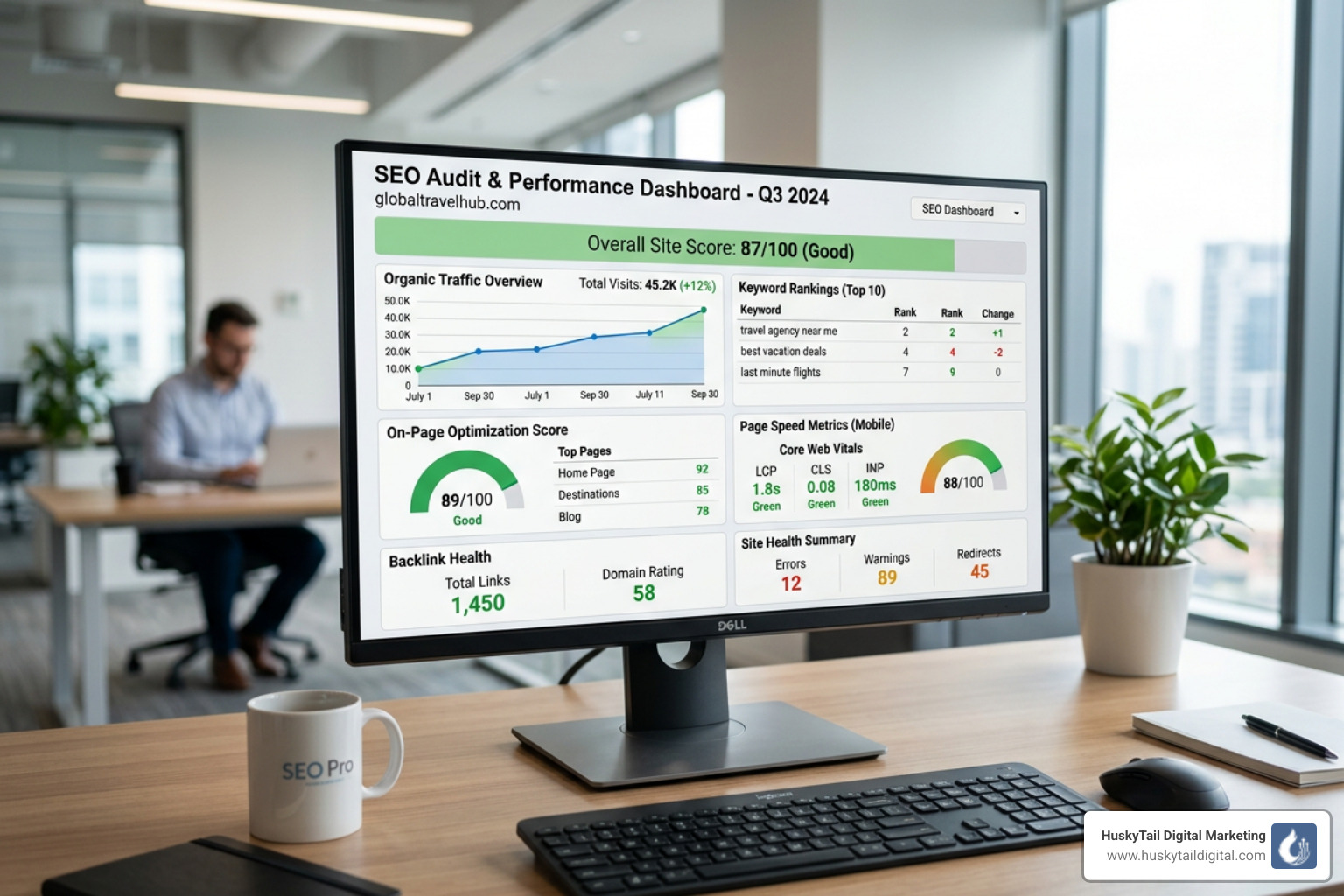
An on page seo service is a professional optimization process that improves the elements within your website — content, HTML tags, page structure, internal links, and more — so search engines can find, understand, and rank your pages for the right searches.
Here's a quick breakdown of what's included:
- Title tags & meta descriptions — Optimized for keywords and click-through rate
- Header structure (H1–H4) — Organizes content for both users and crawlers
- Keyword placement — Strategic use of target, LSI, and entity keywords
- Image optimization — Descriptive file names and alt text
- Internal linking — Connects pages and distributes authority
- URL structure — Clean, keyword-rich, and crawlable
- Schema markup — Structured data for rich results
- Content quality — Aligned with user intent and E-E-A-T standards
The stakes are real. The first organic result on Google earns a 28.5% click-through rate. By position ten, that drops to just 2.5%. If your pages aren't optimized, you're invisible — no matter how good your product or service is.
On-page SEO is the foundation everything else is built on. Technical SEO and off-page link building only amplify what's already working on the page. Without strong on-page fundamentals, even the best backlinks won't move the needle.
I'm Stephen Gardner, founder of HuskyTail Digital Marketing and a 20+ year SEO strategist who has used on page seo service frameworks to move clients from page three to top-three positions for competitive keywords — including a legal client whose qualified leads jumped 62% in under 90 days. In this guide, I'll walk you through exactly how a professional on-page SEO audit works, element by element, so you know what to look for and what to fix.
The Foundation of an On-Page SEO Service
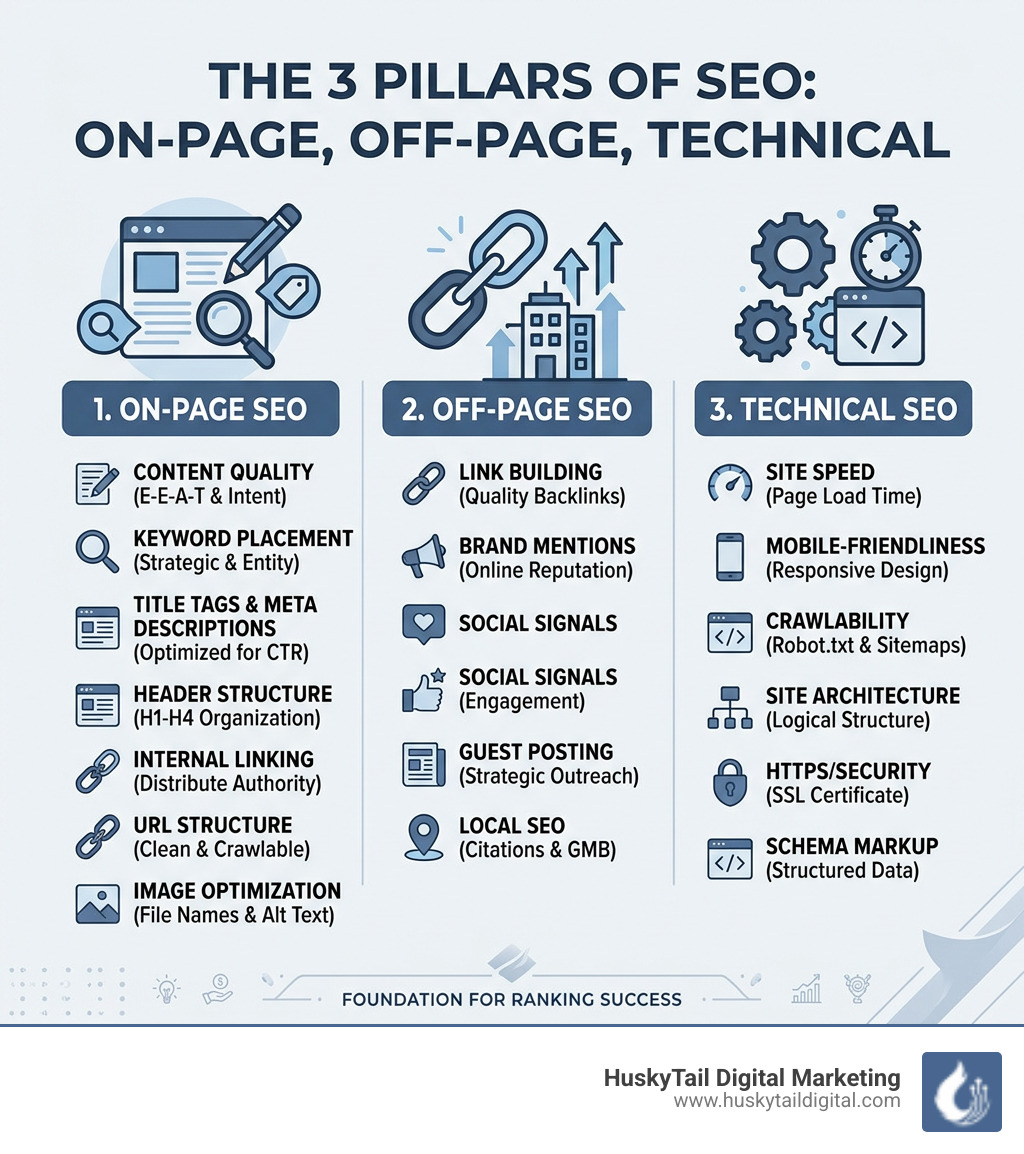
When we talk about a professional on page seo service, we are looking at the DNA of your website. While off-page SEO is about what others say about you (backlinks) and technical SEO is about how your site functions (speed and code), on-page SEO is about the message you are sending directly to Google. It is the foundational pillar that determines how search engines interpret your relevance.
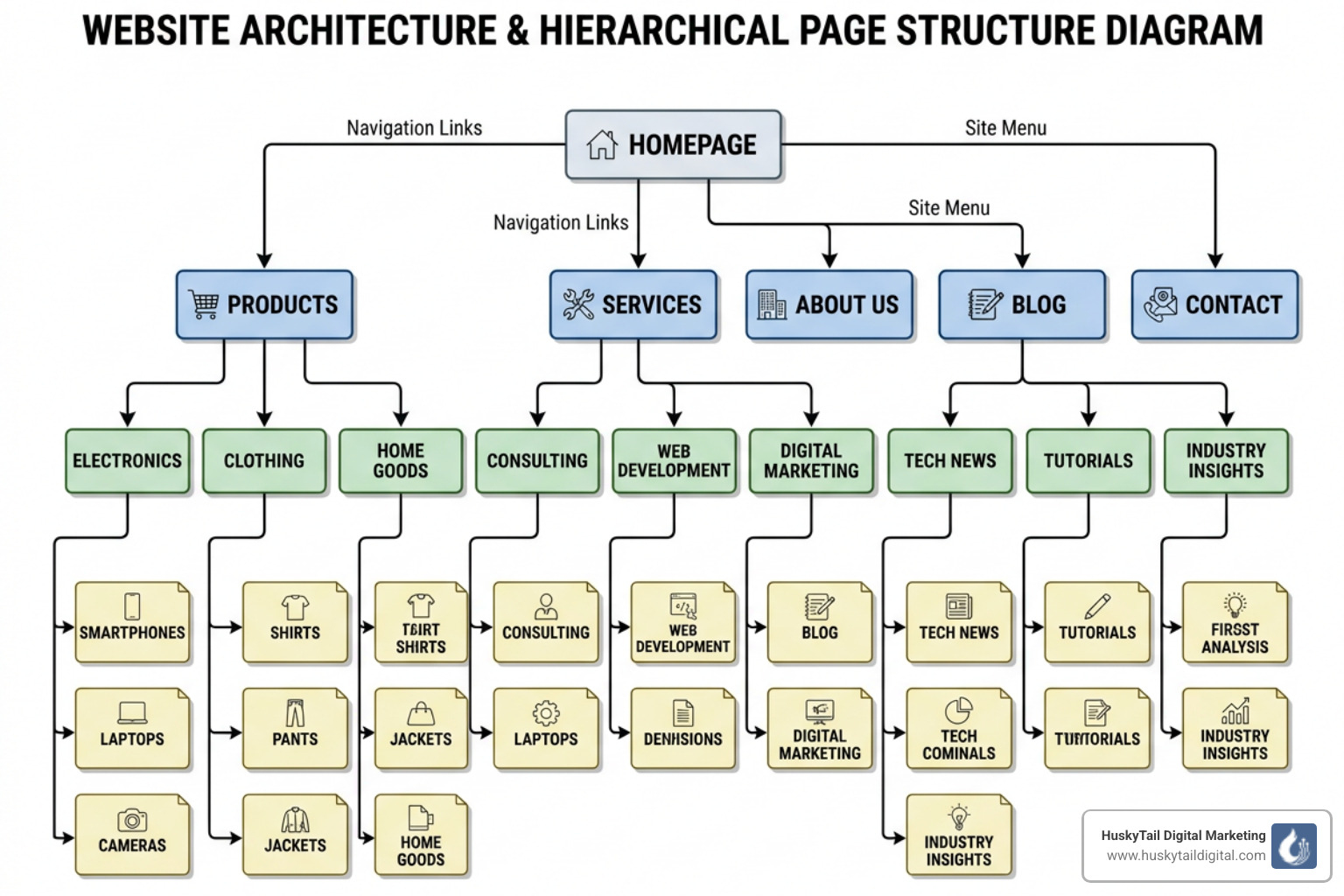
At its core, an on page seo service focuses on two primary goals: making your site easy for search engines to understand and making it valuable for users to read. This involves aligning your content with specific search queries, optimizing your HTML source code, and ensuring your page structure flows logically. If your on-page elements are messy, Google’s bots will struggle to categorize your site, and your rankings will suffer regardless of how many backlinks you have.
To understand how these pieces fit together, take a look at the comparison below:
| SEO Type | Primary Focus | Key Elements |
|---|---|---|
| On-Page SEO | Content & Page Elements | Keywords, Meta Tags, Internal Links, Content Quality |
| Technical SEO | Backend & Performance | Site Speed, Mobile-Friendliness, Crawlability, HTTPS |
| Off-Page SEO | Authority & Reputation | Backlinks, Brand Mentions, Social Signals, Local Citations |
For more details on how these strategies work together to grow your business, you can explore our comprehensive SEO page.
Why Your Business Needs a Professional On-Page SEO Service
In search, being on page two is essentially the same as being invisible. Statistics show that the first five organic search results receive a staggering 67.6% of total click-throughs. If you aren't dominating the top of the first page, you are losing leads to your competitors every single day.
A professional on page seo service ensures you don't just "exist" online, but that you thrive. Beyond just rankings, on-page optimization drastically improves the user experience. When a page is well-structured with clear headers and relevant content, users stay longer, reducing your bounce rate and increasing your chances of conversion. This is particularly vital for smaller enterprises; conducting SEO audits for small business can uncover "low-hanging fruit" optimizations that lead to quick wins in local search results.
The Technical Pillars: Indexation and Accessibility
Before Google can rank your content, it has to be able to see it. This is where indexation comes into play. Think of Google’s bots as scouts scouring the web. Your first job in tuning your on-page SEO is to make sure that web crawlers can access your site. If these bots are blocked or get lost in a maze of broken links, your content will never appear in search results.
One of the most critical tools in your arsenal is the robots.txt file. This file acts as an instruction manual you can post to search engine bots in your top-level directory. It tells them which pages they should crawl and index, and which ones to avoid (like your admin login or private folders). While it is actually harder to stop Googlebot from finding your site than it is to let it in, a poorly configured robots.txt can accidentally hide your most important pages.
To ensure everything is running smoothly, we recommend following a Technical SEO complete guide. This includes the creation of XML sitemaps. A sitemap is essentially a roadmap of your website that helps crawlers find all your pages quickly. Following the Sitemaps.org protocol ensures your sitemap is formatted in a way that Google, Bing, and Yahoo can all easily digest.
URL Structure and Site Hierarchy
A "messy" URL is a missed opportunity. Compare yourdomain.com/p=123 to yourdomain.com/on-page-seo-service. The second one tells both the user and the search engine exactly what the page is about. We advocate for static, concise URLs that use hyphens to separate words.
Site hierarchy is equally important. Using breadcrumbs helps users navigate and helps Google understand the relationship between different sections of your site. During a deep dive into how to audit technical SEO, we often look for duplicate content issues. Sometimes, different URL versions (like http vs https) can cause Google to register that as duplicate content, which can dilute your ranking power. Using canonical tags tells Google which version is the "master" copy. To find these issues, tools like Screaming Frog are invaluable for crawling up to 500 URLs for free to spot errors.
Content Optimization: Beyond Keyword Stuffing
The days of repeating a keyword fifty times in a single paragraph are long gone. Modern on page seo service strategies focus on quality and relevance. However, the "invisible" elements of your content still need precise tuning.
- Title Tags: These are the primary way search engines identify your page topic. They should be under 70 characters and unique to every page.
- Meta Descriptions: While not a direct ranking factor, these influence your click-through rate. Keep them under 160 characters and make them compelling.
- Header Hierarchy: Use one H1 tag per page for your main title, followed by H2s and H3s to break up the text. This makes your content scannable for both humans and bots.
- Image Optimization: Search engines can't "see" images, so they rely on titles and alt tags to understand them. Always use descriptive file names and alt text that includes your target keywords where natural.
Furthermore, a robust internal linking SEO strategy is essential. By linking to other relevant pages on your site, you keep users engaged longer and pass "link equity" to your most important service pages.
Keywords, LSI Terms, and Entity Recognition
Keyword density is a delicate balance. Research suggests that exact match keywords should hit a 7% to 12% density range for optimal results, while entity and LSI (Latent Semantic Indexing) keywords—terms related to your main topic—should sit between 3% and 7%. This prevents "keyword stuffing" while signaling to Google that your content is comprehensive.
Semantic SEO goes a step further by focusing on topics rather than just strings of text. This is where schema markup for WordPress comes in. By using structured data schemas, you can tell Google exactly what your data represents—whether it's a review, a product price, or an event date. This increases your chances of appearing in "Position Zero" or as a rich snippet.
Finally, we always optimize for E-E-A-T (Experience, Expertise, Authoritativeness, and Trustworthiness). Google wants to provide users with the most reliable information possible, so your content must reflect true expertise in your niche.
Enhancing User Experience and Performance Signals
Google has made it clear: if your site is slow or hard to use on a phone, you won't rank. Mobile traffic overtook desktop traffic years ago, making mobile optimization a mandatory part of any on page seo service.
If you’re in doubt about your site's performance, Google offers a free test you can use to find out if your site is considered "mobile-friendly." Beyond just looking good, your site needs to be fast. We utilize various WordPress website optimization techniques to improve Core Web Vitals—a set of specific metrics Google uses to measure load speed, interactivity, and visual stability.
Security is also a ranking signal. Ensuring your site uses HTTPS is no longer optional; it is a basic requirement for building trust with both users and search engines.
Measuring the Success of Your On-Page SEO Service
How do you know if your on page seo service is actually working? You look at the data. We rely heavily on Google Search Console to track "impressions"—how often your site appears in search results—and Google Analytics to see how users behave once they arrive.
Effective optimization should lead to a visible "uplift" in rankings within 7 to 10 days, though competitive industries may take up to three weeks. We provide our clients with a full report of tasks completed, including keyword tracking and conversion rate analysis. If you're doing this yourself, using the right SEO technical audit tools will help you monitor your progress and catch errors before they impact your traffic.
Frequently Asked Questions about On-Page SEO
What is the difference between on-page and technical SEO?
While they overlap, on-page SEO focuses on the content and elements users interact with (like keywords, titles, and images). Technical SEO focuses on the backend infrastructure that helps search engines crawl and index the site (like site speed, XML sitemaps, and server status). Think of on-page as the interior design and technical as the plumbing and electricity.
How often should I review my on-page SEO elements?
SEO is not a "set it and forget it" task. You should review your on-page elements at least quarterly. However, if you are in a highly competitive industry or frequently adding new content, a monthly review is better. Search algorithms and competitor strategies change constantly, and your site needs to evolve to stay ahead.
What are the most common on-page SEO mistakes to avoid?
The biggest mistakes include:
- Keyword Stuffing: Overloading pages with keywords until they are unreadable.
- Missing Alt Text: Leaving images without descriptions.
- Duplicate Title Tags: Using the same title for every page on your site.
- Thin Content: Having pages with less than 300 words that provide little value.
- Ignoring Mobile Users: Having a site that is difficult to navigate on a smartphone.
Conclusion: Leading the Herd with HuskyTail Digital
Navigating the complexities of an on page seo service can feel like a daunting task, but you don't have to do it alone. At HuskyTail Digital Marketing, we combine 20+ years of experience with AI-powered SEO strategies to deliver data-backed results for businesses in cities like Atlanta, Chicago, Miami, and New York.
We believe in more than just rankings; we believe in making an impact. Through our Hearts for Huskies initiative, we combine expert marketing with charitable giving, ensuring that as your business grows, we're also helping our four-legged friends find their forever homes.
If you’re ready to stop blending in and start standing out, it’s time to take control of your search visibility. At HuskyTail Digital Marketing - We Don't Follow the Pack, We Lead the Herd.
Start your on-page SEO audit with us today and watch your organic traffic transform.


.avif)

.webp)
.avif)


