
-p-1080.webp)






Why Your Internal Linking SEO Strategy Is The Hidden Engine Behind Your Rankings
An internal linking SEO strategy is a deliberate system of connecting your website's pages to each other — helping search engines discover and rank your content, while guiding users deeper into your site.
Here's a quick summary of what an effective strategy looks like:
Most business owners focus entirely on getting backlinks from other websites. That makes sense — external links are powerful. But internal links? They're completely under your control, and they decide how that authority flows through your site.
Ignore them, and you're essentially leaving rankings on the table.
Think of it this way: your homepage likely has far more backlinks than any other page on your site — in many cases, more than 20 times the authority of your second most-linked page. Internal links are how you spread that strength to the pages that actually convert visitors into customers.
I'm Stephen Gardner, founder of HuskyTail Digital Marketing, with over 20 years of experience building internal linking SEO strategies that have recovered penalized sites, boosted organic traffic by up to 75%, and moved key pages from page three to top-three positions. In the sections ahead, I'll walk you through every step — from site architecture to anchor text to auditing — so you can build a strategy that actually moves the needle.
The Core Mechanics: What Are Internal Links And Why Do They Matter?
Before we dive into the "how-to," let’s get our definitions straight. An internal link is a hyperlink that points from one page on your domain to another page on that same domain. It’s the digital equivalent of a doorway in your house leading from the kitchen to the dining room.
In contrast, external links (or backlinks) lead users away from your site to a different domain entirely. While both are vital, they serve different masters.
Why does this matter so much for your internal linking SEO strategy? Google explains: “Some pages are known because Google has already crawled them before. Other pages are discovered when Google follows a link from a known page to a new page.”
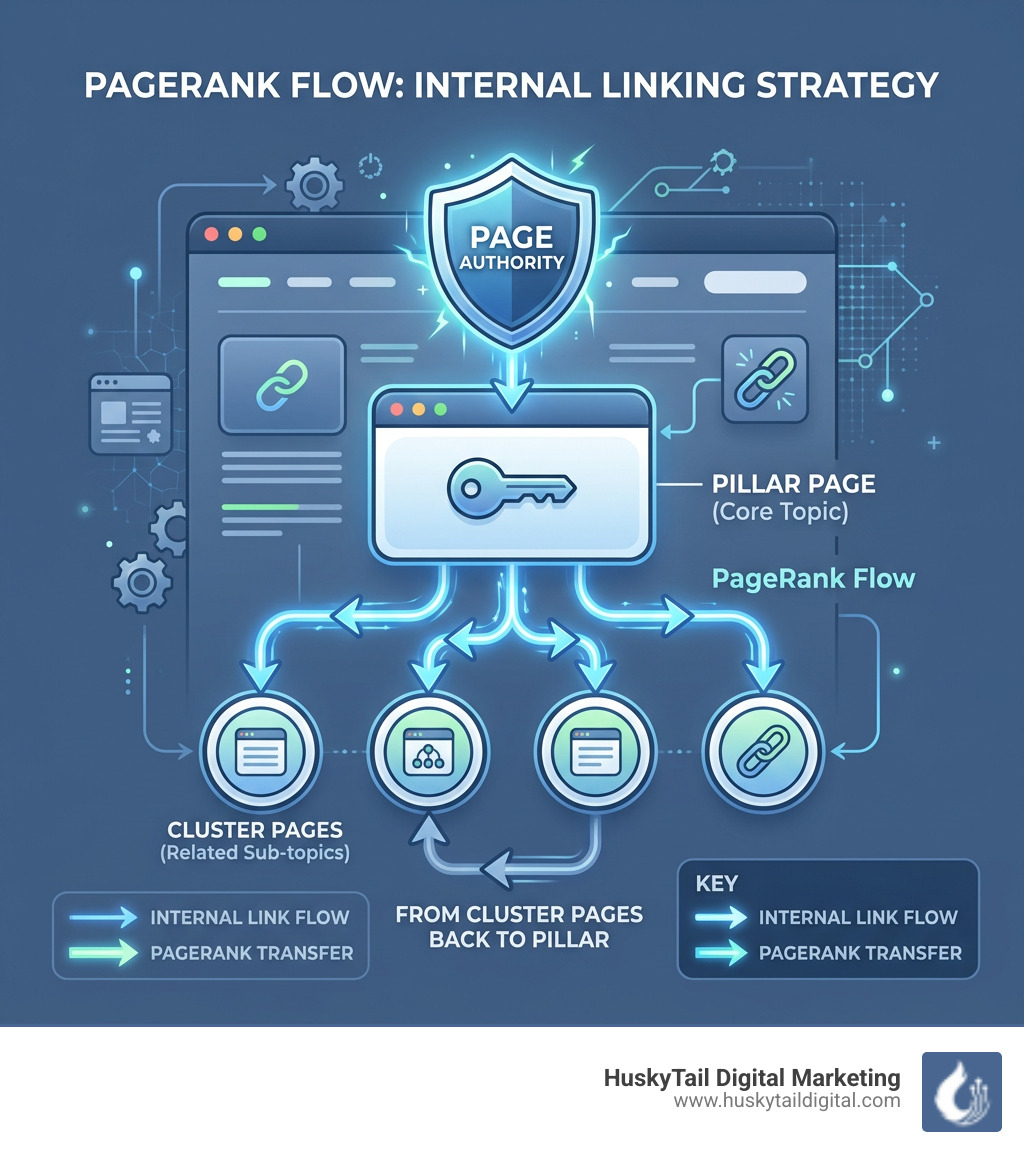
Without these links, your content is essentially invisible to search bots. Beyond discovery, these links are the primary vehicle for “passing link equity” or PageRank. This is the "SEO juice" that gives a page the power to rank. If your homepage is a massive reservoir of authority, your internal links are the pipes that carry that water to thirsty blog posts and service pages. By distributing this authority, you improve overall site performance and ensure your most important pages have the strength to compete.
For those looking to dive deeper into how this fits into a broader marketing plan, check out More info about SEO services.
Different Types of Internal Links
Not all links are created equal. To build a robust internal linking seo strategy, we need to use a variety of link types:
- Navigational Links: These are the permanent fixtures in your header and footer. They help users (and bots) find your most important "hub" pages, like your Services or About page.
- Contextual Links: These are the gold standard for SEO. They appear naturally within the body of your content. When we link to a related article mid-sentence, we are telling Google, "These two topics are related."
- Breadcrumbs: These are the small text paths usually found at the top of a page (e.g., Home > Blog > SEO Tips). Google recommends these because they help orient visitors and provide a clear hierarchical trail for crawlers.
- Footer Links: While less powerful than contextual links, these provide a "safety net" for navigation and help distribute equity to secondary pages like Privacy Policies or Contact forms.
- Image Links: If you use an image to link to another page, Google uses the "alt text" as the anchor text. It's a great way to improve accessibility while boosting SEO.
Understanding these technical nuances is a cornerstone of More info about Technical SEO.
Building A High-Performance Internal Linking SEO Strategy
To succeed, you can't just sprinkle links like confetti and hope for the best. You need a blueprint. We recommend a "pyramid-style" site hierarchy. At the very top is your homepage. Below that are your pillar pages, followed by your cluster content, and finally, your specific long-tail articles.
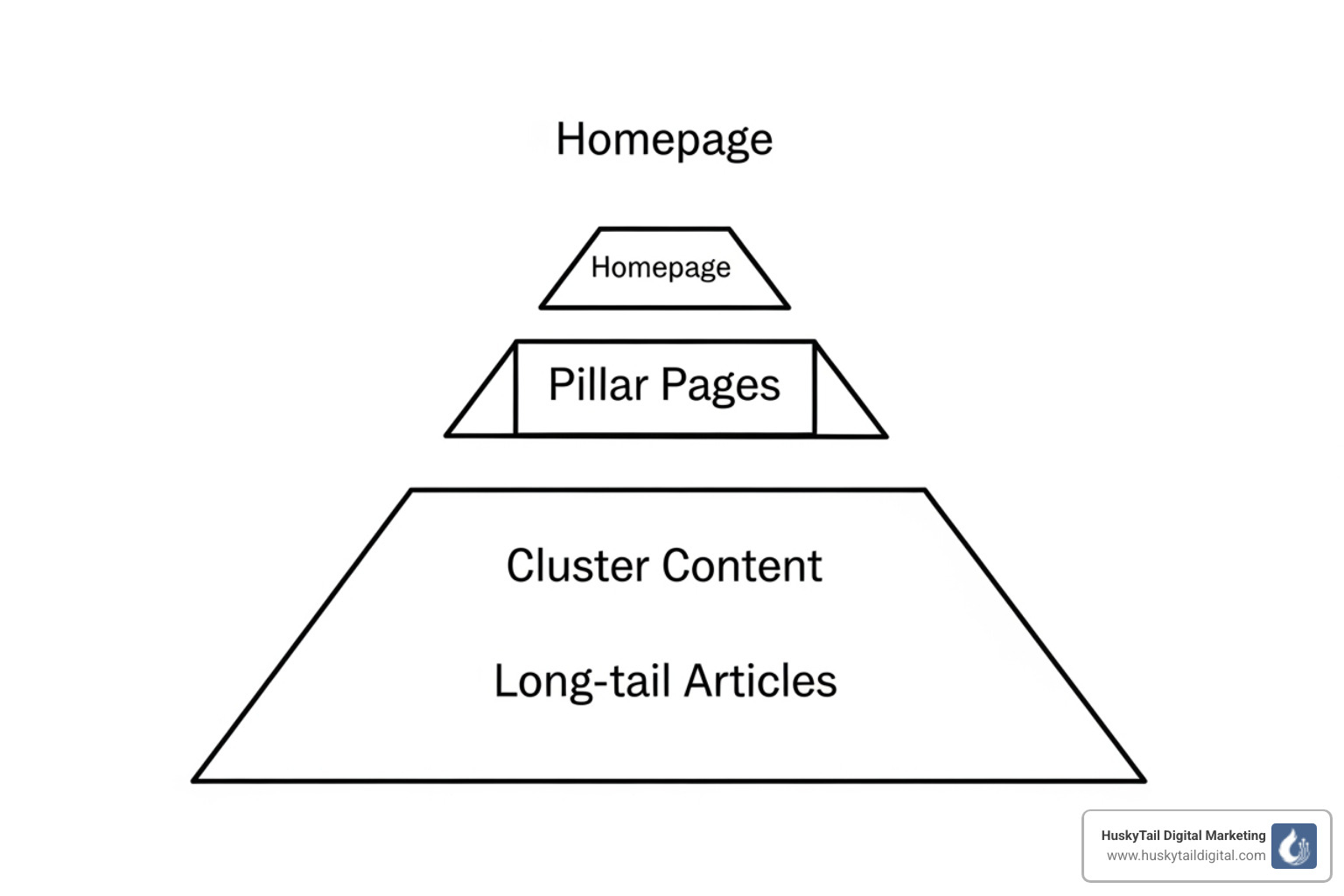
A pillar page is a comprehensive resource that targets broad, high-volume keywords. For example, if you sell appliances, your pillar page might be "The Ultimate Guide to Washing Machines" (a keyword that gets roughly 18,100 searches per month).
From this pillar, you link out to more specific "cluster" pages, such as "Best Front-Load Washers" or "How to Repair a Washing Machine Drum." This linking strategy creates a logical content hierarchy. It tells search engines exactly which page is the "authority" on the broad topic while showing that you have deep expertise in the sub-topics.
This systematic authority distribution is what allows smaller sites to outrank giants. To see how this works with external efforts, explore More info about Link Building.
Leveraging Topic Clusters for Internal Linking SEO Strategy
The magic happens when you interlink within these topic clusters. Semantic relevance is the key here. Google no longer just looks at keywords; it looks at entities and relationships.
When your cluster pages link back to the pillar (upward linking) and to each other (horizontal linking), you create a "web" of relevance. This reinforces your topical authority. If every one of your 10 articles about "Orlando Real Estate" links back to your main "Orlando Homes for Sale" pillar, Google receives a loud, clear signal that your pillar page is the most important destination for that topic.
This is a core component of any More info about Link Building Complete Guide.
Auditing And Fixing Common Internal Linking Issues
Even the best internal linking seo strategy can fall apart without maintenance. Websites are living things; pages get deleted, URLs change, and links break.
We recommend a monthly audit to catch these common "ranking killers":
- Broken Links: These lead to 404 errors, frustrating users and wasting your "crawl budget." You must fix broken internal links by either removing them or updating the URL.
- Orphaned Pages: These are pages that have zero internal links pointing to them. Because search engines rely on links to find content, orphaned pages often fail to get indexed at all. If you don't link to it, Google assumes it isn't important.
- Excessive Crawl Depth: According to Google, pages with fewer clicks often rank higher. If a user has to click more than three times from the homepage to find a page, that page is buried.
- Redirect Chains: When Link A points to Redirect B, which finally points to Page C, you lose link equity at every jump. You should always audit for redirects and update links to point directly to the final destination.
- Unsecured Links: Ensure all your internal links use HTTPS. Using HTTPS for a secure site is a ranking factor, and linking to old HTTP versions can trigger security warnings.
Regularly performing these checks is vital. Learn more at More info about SEO Audits.
Essential Tools for Your Internal Linking SEO Strategy
You don't have to do this manually. There are powerful tools designed to map out your site's "nervous system":
- Google Search Console: The "Links" report here is free and shows you exactly which pages Google thinks are your most linked-to internal targets.
- Semrush Site Audit: This provides a dedicated internal linking report, flagging everything from "too many links on a page" to "permanent redirects."
- Screaming Frog: This is the industry standard for technical crawls. It allows you to visualize your link architecture and identify crawl depth issues instantly.
- Link Graph Tools: These create a visual map of your site, helping you spot clusters that are isolated or pillars that aren't getting enough love.
For a full breakdown of the auditing process, see More info about SEO Audits Complete Guide.
Optimization Best Practices: Anchor Text And Placement
How you link is just as important as where you link.
Anchor Text Best Practices:Your anchor text is the clickable blue text of a link. Google recommends using descriptive, concise text that gives the user a clear idea of what they will find on the other side.
- Avoid Generic Text: "Click here" or "Read more" tells Google nothing.
- Use Keyword-Rich Text: If you're linking to a page about "pet grooming in Atlanta," use that phrase (or a variation) as your anchor.
- Don't Over-Optimize: While manipulating external anchor text can lead to penalties, internal links are much safer. However, using the exact same keyword for every single internal link can still look "spammy" to bots. Mix it up!
Link Placement:Location, location, location. Links placed higher up in your content (the "top 30%") generally carry more weight. This is because users are more likely to click them, and Google associates early links with higher relevance.
Link Volume:How many links is too many? John Mueller has said there isn't a hard limit, but having hundreds of links on a single page can confuse Google’s crawlers. It also dilutes the authority being passed. If you have 100 links on a page, each link only gets a tiny fraction of the equity.
Lastly, always use "do follow" attributes for internal links. You want the authority to flow freely! For more on these technical settings, check out More info about Technical SEO Complete Guide.
Frequently Asked Questions About Internal Linking
How many internal links per page is ideal for SEO?
There is no "magic number," but link density should always prioritize user experience. A Zyppy survey found that pages with 50+ links often see a decline in traffic. A good rule of thumb is to aim for 5-10 internal links per 2,000 words. If you add too many, you hit a point of diminishing returns where each link becomes less valuable.
How do internal links improve user experience and engagement?
Internal links are essentially a "choose your own adventure" for your visitors. By providing clear navigation to related topics, you increase "dwell time" (how long someone stays on your site) and reduce "bounce rate" (people leaving after one page). Search engines see high engagement as a signal that your content is valuable. Furthermore, strategic linking creates conversion funnels, guiding a user from a "top-of-funnel" blog post to a "bottom-of-funnel" service page.
What mistakes should you avoid in internal linking?
One of the biggest pitfalls is automation. While some tools can help, relying entirely on an internal linking strategy for SEO that is fully automated often leads to irrelevant links and "spammy" anchor text. Other mistakes include:
- Using the same anchor text for two different pages: This confuses Google about which page should rank for that keyword.
- Nofollow misuse: Never "nofollow" your own internal links. While nofollow links can be useful when used externally, using them internally effectively kills the flow of authority.
Conclusion
At HuskyTail Digital Marketing, we believe that an internal linking seo strategy isn't just a technical task — it's an act of strategic intent. It is about building a digital ecosystem where every piece of content supports the next, ensuring that your best work gets the visibility it deserves.
Our AI-powered SEO approach combines expert human intuition with data-backed results to ensure your site architecture is flawless. Whether you're in Atlanta, Austin, or New York, we help businesses across the United States dominate their local and national markets.
Plus, when you work with us, you're helping more than just your bottom line. Through our Hearts for Huskies initiative, we combine top-tier marketing with charitable giving to support husky rescues across the country.
Ready to stop following the pack? Let's build a site that leads the herd. For more information and to start your journey, explore More info about SEO.
At HuskyTail Digital Marketing - We Don't Follow the Pack, We Lead the Herd.


.avif)

.webp)
.avif)


