
-p-1080.webp)






Why Most Websites Are Invisible (And How a Comprehensive SEO Audit Fixes That)

Knowing how to conduct a comprehensive seo audit for your website is the single most important skill you can develop to stop losing organic traffic to competitors. Here's the short version:
How to conduct a comprehensive SEO audit — quick steps:
- Benchmark current performance — record organic traffic, rankings, and backlink count
- Check crawler access — review robots.txt and XML sitemap
- Fix technical issues — broken links, redirect chains, HTTPS, duplicate URLs
- Test speed and mobile — Core Web Vitals (LCP, INP, CLS) and mobile-friendliness
- Audit on-page elements — title tags, meta descriptions, H1-H3 headers, image alt text
- Review content quality — thin content, keyword cannibalization, content gaps
- Analyze backlinks — identify toxic links, find new opportunities
- Run competitor analysis — benchmark your authority, keywords, and gaps
- Check AI and SERP visibility — featured snippets, AI overviews, brand mentions
- Build an action plan — prioritize fixes by impact, track results
Here's the uncomfortable truth: 96.55% of web pages get zero organic traffic from Google. Zero. Not a trickle — nothing. And yet 45.1% of all search result clicks go to organic results. That's an enormous prize that most websites are simply not positioned to win.
A website that looks great can still be completely broken from a search engine's perspective. Crawl errors, slow load times, thin content, and toxic backlinks can silently kill your rankings — often without any obvious warning signs.
That's exactly what a comprehensive SEO audit exposes.
I'm Stephen Gardner, founder of HuskyTail Digital Marketing and a 20+ year SEO strategist who has used comprehensive SEO audits to recover penalized sites, double organic traffic in under 90 days, and move clients from page 3 to top-3 rankings for competitive keywords. In this guide, I'll walk you through the same audit framework I use to help ambitious businesses learn how to conduct a comprehensive seo audit for your website — and turn their online presence into a real growth engine.
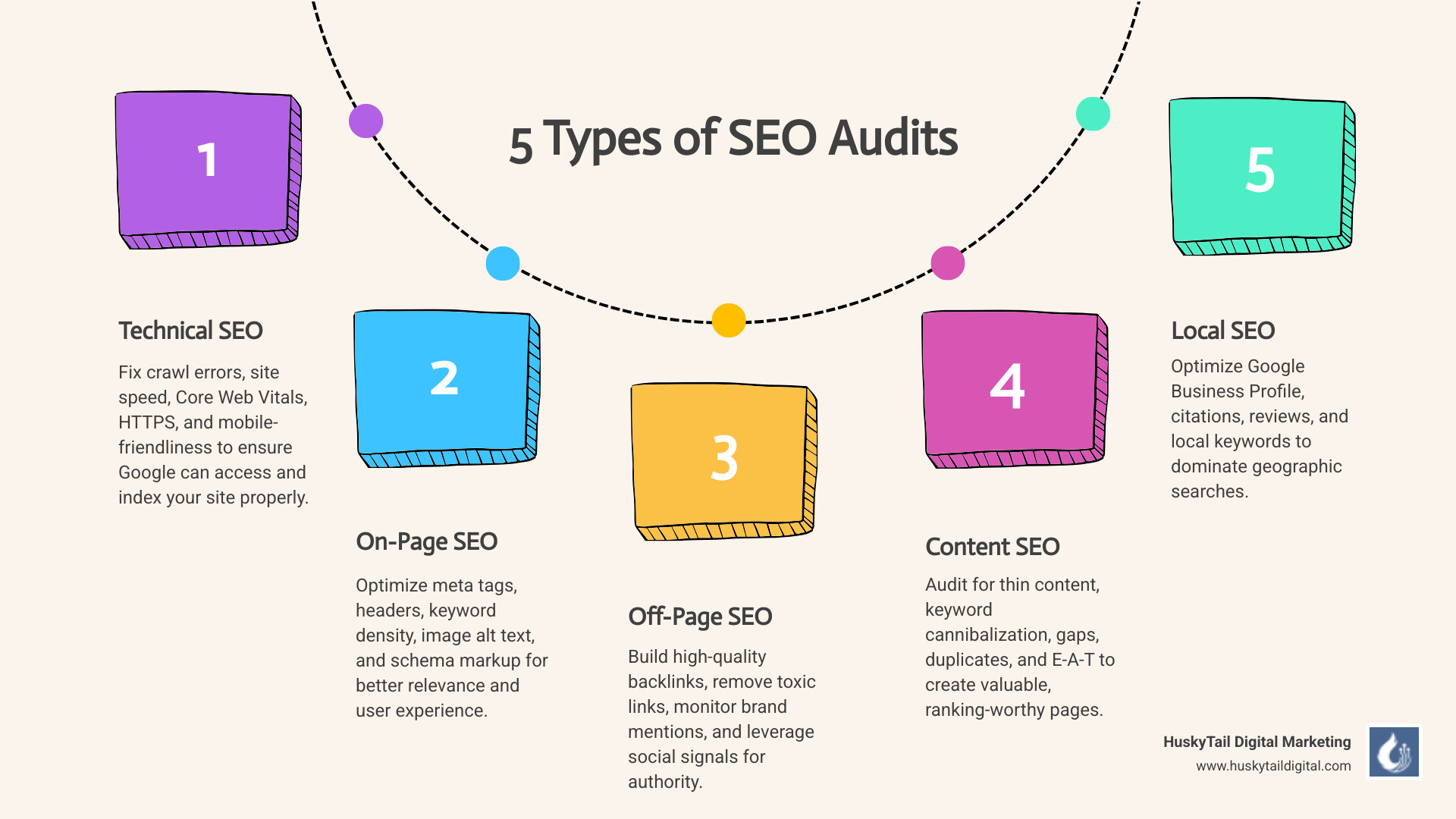
The Core Pillars: Why and How to Conduct a Comprehensive SEO Audit for Your Website
At HuskyTail Digital Marketing, we view an SEO audit as a full-body medical checkup for your website. You wouldn’t try to run a marathon with a broken toe, and you shouldn’t try to dominate the search results in cities like Atlanta, Dallas, or Chicago with a site that has underlying health issues.
With 45.1% of all search result clicks coming from organic search, the stakes are high. If your site isn't performing, you're essentially handing customers to your competitors on a silver platter. A comprehensive audit doesn't just find "errors"; it uncovers opportunities to improve the user experience (UX) and boost conversion rates. When a site is easy for Google to read and a joy for humans to use, rankings follow naturally.
To get started, we need the right gear. Attempting to audit a site without tools is like trying to see bacteria without a microscope—you’re just guessing. We recommend a stack that includes:
- Google Search Console (GSC): Our direct line to Google. It tells us what they see, what they’ve indexed, and where they’re struggling.
- Screaming Frog SEO Spider: A powerful crawler that mimics how search engines navigate your site to find broken links and duplicate content.
- Semrush or Ahrefs: Essential for competitive benchmarking, keyword tracking, and backlink analysis.
- Google Analytics: To see how humans are actually interacting with your pages once they arrive.
For a deeper dive into the methodology, you can explore our SEO Audits Complete Guide. We don't just want to fix what's broken; we want to build a foundation for long-term growth.
Technical Foundation: Crawling, Indexing, and Performance
Before we worry about how pretty your blog posts are, we must ensure Google can actually find them. Technical SEO is the plumbing of your website. If the pipes are clogged, it doesn't matter how expensive the gold faucets are—nothing is getting through.
The first step in how to conduct a comprehensive seo audit for your website is a deep dive into crawlability. We check your robots.txt file to make sure you aren't accidentally telling Googlebot to stay away from your most important pages. We also verify your XML sitemap; it should be clean, up-to-date, and submitted to GSC so search engines have a clear roadmap of your site.
Security is no longer optional. Google has used HTTPS as a ranking signal since 2014. If your site still shows a "Not Secure" warning in Chrome, you're losing trust and rankings simultaneously. We also look at site architecture—aiming for a "flat" structure where any page can be reached in four clicks or less. For more on this, check out our Technical SEO Audit Guide.
Mastering Technical Elements: How to Conduct a Comprehensive SEO Audit for Your Website
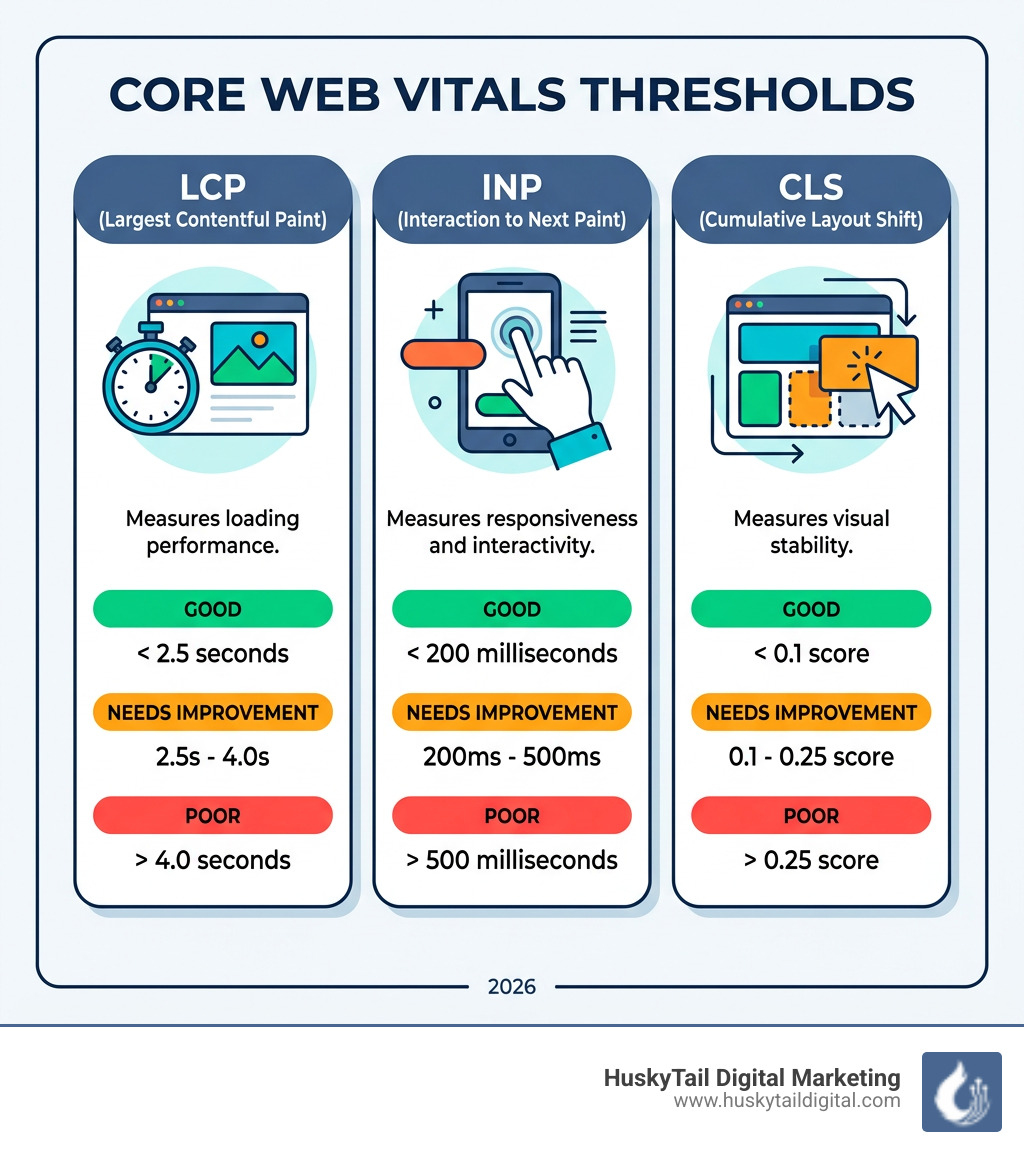
Performance is where many sites stumble. In our world, speed is a "must-have." One in two consumers will ditch a website that takes more than six seconds to load. Google measures this through Core Web Vitals, a set of metrics that look at:
- LCP (Largest Contentful Paint): How fast the main content loads (aim for < 2.5s).
- INP (Interaction to Next Paint): How responsive the site is to user input (aim for < 200ms).
- CLS (Cumulative Layout Shift): Does the page jump around while loading? (aim for < 0.1).
You can test these yourself using Google PageSpeed Insights.
Mobile-friendliness is equally critical, as 63% of organic search engine visits now come from mobile devices. If your buttons are too small or your text is hard to read on a smartphone, you're effectively invisible to more than half of your potential audience.
Finally, we hunt for "link rot." Ahrefs found that 66.5% of links to sites over the last nine years are dead. Broken links and long redirect chains frustrate users and waste your "crawl budget." Fixing these is a quick win. If you're asking, "How Can I Audit My Website for Technical SEO," starting with these performance metrics is the answer.
On-Page Strategy and Content Quality
Once the technical foundation is solid, we turn our attention to what's actually on the page. On-page SEO is about making your content understandable to both search engines and humans. This starts with your meta tags.
Your title tags should be unique, include your primary keyword, and stay under 55-60 characters to avoid being cut off. Meta descriptions (around 105-155 characters) should act as an advertisement for your page, enticing users to click. While Google sometimes rewrites these, having an optimized original increases your chances of a high click-through rate.
We also look at your header structure (H1 for the main title, H2s and H3s for subtopics) and keyword density. We generally aim for a natural 1-2% density. If you're stuffing keywords in like a Thanksgiving turkey, Google will notice—and they won't be happy.
| Feature | Thin Content | Pillar Content |
|---|---|---|
| Word Count | Usually < 300 words | 1,500+ words |
| Value | Little to no unique insight | Comprehensive, expert-led |
| Multimedia | Text only | Images, videos, infographics |
| Internal Links | Few or none | Strategically linked to related topics |
To help with this, tools like the SEO Content Checker Chrome extension can be incredibly useful for a quick quality check. Don't forget image alt text; it helps visually impaired users and tells Google what your images represent.
Content Optimization: How to Conduct a Comprehensive SEO Audit for Your Website
The most heartbreaking stat in our industry is that 96.55% of content gets no organic traffic. To avoid being part of that group, your content must meet high E-E-A-T standards (Experience, Expertise, Authoritativeness, and Trustworthiness).
During a content audit, we look for:
- Keyword Cannibalization: This happens when multiple pages on your site compete for the same keyword. It confuses Google and dilutes your ranking power. We often fix this by consolidating those pages into one "power post."
- Content Gaps: What are your competitors in Phoenix or Boston talking about that you aren't? Identifying these gaps allows you to create new content that captures missed traffic.
- Duplicate Content: Using a tool like Copyscape helps ensure your content is unique. For ecommerce sites, we pay special attention to URL parameters and pagination, which often create accidental duplicates.
If you're wondering How to SEO Audit your content effectively, the key is to be ruthless. If a page isn't serving a purpose or driving traffic, it either needs an AI-powered refresh or it needs to go.
Off-Page Authority and Competitive Benchmarking
The final piece of the puzzle is what happens off your website. Off-page SEO is primarily about building authority and trust. Think of a backlink as a "vote of confidence" from another site. However, not all votes are equal.
A comprehensive audit must include a backlink analysis. We look for high-quality, relevant links and identify toxic links—spammy or manipulative links that could trigger a Google penalty. If we find them, we use Google's Disavow tool to tell the search engine we don't want to be associated with those neighborhoods.
But it's not just about links anymore. In the "new era of search," AI visibility is becoming crucial. We track how AI platforms like ChatGPT, Gemini, and Claude mention your brand. Are they getting your facts right? Do they connect your brand to the right topics? Unlinked brand mentions and social signals are increasingly important factors in how AI and search engines perceive your authority.
For businesses in our service areas—like Miami, San Francisco, or New York—Local SEO is a major focus. We audit your Google My Business listing for accuracy and manage your reviews. Positive reviews can enhance your site’s credibility by up to 73%.
Finally, we benchmark you against the "pack." By looking at 3-5 top competitors, we can see exactly what it will take to outrank them. At HuskyTail Digital Marketing, we don't just want you to keep up; as our tagline says, "At HuskyTail Digital Marketing - We Don't Follow the Pack, We Lead the Herd." You can see more about our approach on our SEO Audits page.
Conclusion
Conducting a comprehensive SEO audit is the first step toward transforming your website from a digital brochure into a high-performance sales machine. It requires a blend of technical precision, creative content strategy, and authoritative link building.
At HuskyTail Digital Marketing, we specialize in AI-powered SEO and website management, providing data-backed results for businesses across the United States—from the tech hubs of Austin and San Jose to the bustling markets of Houston and Philadelphia. We believe in doing good while doing well, which is why a portion of our success supports our Hearts for Huskies initiative.
If you’re ready to see what’s really going on under the hood of your site, visit our SEO Audits page to get started.
What is an SEO audit and why is it essential?
An SEO audit is a comprehensive evaluation of a website's overall "health" regarding its visibility in search engines. It identifies technical errors, content gaps, and off-page issues that prevent a site from ranking. It is essential because search algorithms and competitor strategies are constantly changing; without regular audits, your site will eventually lose its competitive edge and its traffic.
How often should you conduct an SEO audit?
We recommend a comprehensive audit at least twice a year, though quarterly reviews are better for dynamic sites like ecommerce stores. You should also run a mini-audit whenever Google announces a major core update on their Search Central Blog or if you notice a sudden, unexplained drop in organic traffic.
What are the most common SEO audit mistakes?
The biggest mistake is relying solely on automated-only reports. A tool might tell you a link is broken, but it won't tell you why that link was important or how to strategically replace it. Other common errors include:
- Ignoring mobile users: Testing only on desktop when 63% of traffic is mobile.
- Neglecting site speed: Thinking "it's fast enough" without checking Core Web Vitals.
- Failing to prioritize: Trying to fix 500 minor issues at once instead of focusing on the 5 major issues that will move the needle.


.avif)

.webp)
.avif)


