
-p-1080.webp)






Why A Higher Google Ranking Is Your Ultimate Business Asset
Higher Google ranking isn't just a vanity metric—it's the difference between thriving and surviving online. If you're struggling with limited visibility, here's what you need to know:
Quick Answer: How to Achieve a Higher Google Ranking
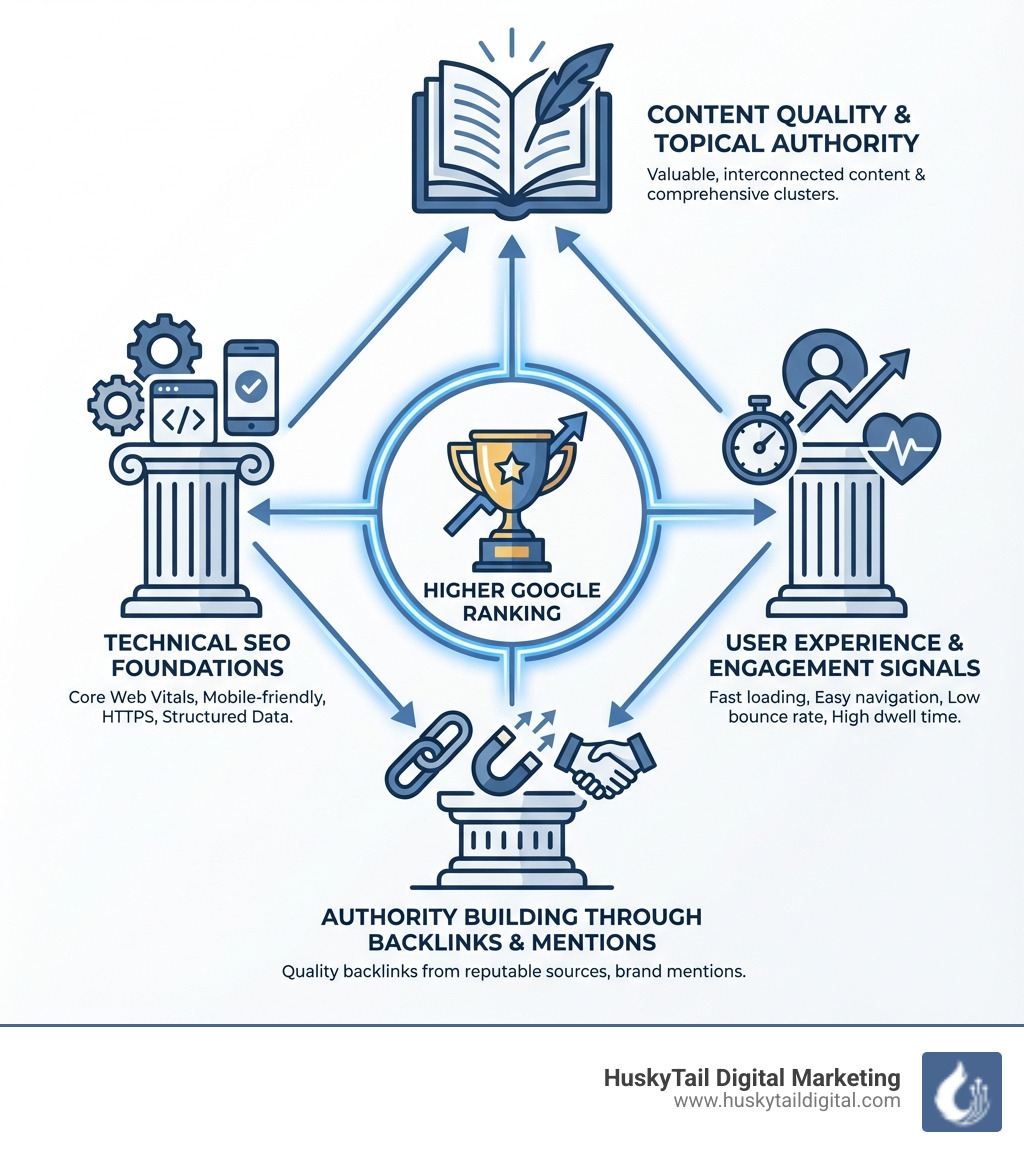
- Create valuable, comprehensive content that directly answers user questions
- Build topical authority through interconnected content clusters
- Optimize technical foundations (Core Web Vitals, mobile-friendliness, HTTPS)
- Earn quality backlinks from reputable sources in your industry
- Optimize for user experience (fast loading, clear structure, easy navigation)
- Leverage your Google Business Profile for local visibility
- Stay current with algorithm updates and AI-powered search features
The stakes couldn't be higher. 75% of users never scroll past the first page of Google search results, and the top three organic results capture nearly 69% of all clicks. For some industries like retail, organic search traffic is worth an estimated $21.8 million.
But here's the reality: Google's algorithm has fundamentally changed. It's no longer just about keywords and backlinks. Today's ranking factors include AI Overviews, passage-level ranking, content satisfaction signals, and E-E-A-T (Experience, Expertise, Authoritativeness, Trust). The search engine now assembles answers by pulling relevant passages from across the web, prioritizes consistently mentioned brands even without backlinks, and rewards content that keeps users engaged without bouncing back to search results.
The good news? You don't need a massive budget or years of experience to compete. You need the right strategy, executed consistently, with a focus on providing genuine value to your audience.
I'm Stephen Gardner, founder of HuskyTail Digital Marketing, and over the past 20+ years I've helped businesses across the nation achieve Higher Google ranking through data-driven, AI-improved strategies that adapt to Google's evolving algorithm. My approach combines technical precision with user-first content creation to deliver measurable results.
Let's break down exactly how you can climb from zero visibility to dominating your market in Google search results.
Handy Higher Google ranking terms:
The New SEO Battlefield: Adapting To AI And Google's Evolving Algorithm
Google's search algorithm has always been a moving target, constantly evolving to deliver the most accurate and helpful results. In 2025, this evolution is more rapid and AI-driven than ever. We're seeing a significant shift from traditional keyword-matching to a deeper understanding of user intent, context, and content quality.
Google's core mission remains "to connect human curiosity to knowledge as accurately as possible." To achieve this, it uses sophisticated systems that consider factors like your location, past search history, and settings to determine relevance. The big game-changer is the rise of AI, particularly Large Language Models (LLMs) like ChatGPT and Gemini, which are fundamentally reshaping how search results are presented and ranked.
This means we're moving beyond simple "blue links" to a world dominated by AI Overviews (AIOs) and the Search Generative Experience (SGE). These features often provide direct answers within the search results page, sometimes even before you click a link. This shift introduces "passage-level ranking," where Google doesn't just rank entire pages, but extracts and highlights specific, relevant sections of content. This also places a huge emphasis on E-E-A-T: Experience, Expertise, Authoritativeness, and Trust. Google explicitly states that its systems surface high-quality information based on these very factors.
What does this mean for SEO? It means our content needs to be structured, trustworthy, and comprehensive enough for AI to understand and extract key information. It also means building a brand that Google recognizes as a reliable source, even if it doesn't always involve a direct backlink.
Optimizing for AI Overviews and Passage Ranking
To truly achieve a Higher Google ranking in this AI-driven landscape, our content strategy must adapt. AI Overviews and passage ranking are all about providing concise, direct answers, and our job is to make it easy for Google's AI to find those answers within our content.
How do we do this?
- Structured Content: We organize our content with clear, logical headings (H2, H3) that accurately reflect the sections below them. This is beneficial for human readability and crucial for AI to understand the different topics covered.
- Direct Answers: We answer common questions explicitly and concisely at the beginning of relevant sections. Think of it as leading with the answer, then expanding with helpful context and examples.
- Using Lists and Tables: Information presented in bulleted or numbered lists and tables is highly digestible for both users and AI. Google might even pick these lists and show them as featured snippets or highlight them in AI Overviews when our content aligns with a search query.
- Comprehensive Coverage: While we keep key explanations succinct, we also ensure our content is comprehensive, covering all major aspects of a topic. This signals to AI that our page is a valuable, in-depth resource.
At HuskyTail Digital Marketing, we leverage an internal AI Visibility Toolkit to analyze how AI systems understand and summarize content. This toolkit helps us identify gaps, clarify structure, and surface the most important takeaways. We then fine-tune our clients' content to maximize its chances of appearing in AI Overviews and passage-level rankings, so our clients can compete effectively in this new search environment.
Understanding and Improving Content Satisfaction Signals
Beyond what the AI sees in our content, Google also pays close attention to how users interact with it. These are what we call content satisfaction signals. While Google notes that not all user experience signals are directly used for ranking, they clearly align with success in search and are worth focused attention. In the AI era, these signals are more important than ever.
Key signals we focus on include:
- Dwell Time: How long users spend on our page after clicking through from search results. Longer dwell times often indicate that users found the content valuable and satisfying.
- Bounce Rate: The percentage of users who leave our site after viewing only one page. A high bounce rate might suggest that the content did not meet their expectations or was not relevant to their query.
- Click-Through Rate (CTR): The percentage of users who click on our listing in the search results. A higher CTR suggests our title and meta description are compelling and accurately reflect the content.
- Pogo-sticking: This is when a user clicks on our result, quickly returns to the search results page, and then clicks on another result. This strongly suggests our content failed to satisfy the user's intent.
To improve these signals, we focus on providing comprehensive answers that truly solve the user's problem. Our goal is to be the last click, meaning users find everything they need on our page and do not need to return to Google for the same query. This requires content that is clear, well-structured, engaging, and directly addresses the search intent behind the keyword.
We regularly review Google's guidelines on quality content and align our content planning, editing, and measurement processes with these expectations. By combining those guidelines with our AI-powered analysis, we help clients publish content that satisfies both users and search engines.
Mastering Content For A Higher Google Ranking
Content is king, queen, and the entire royal court when it comes to achieving a Higher Google ranking. But it's not just about writing; it's about strategic content creation that builds topical authority, satisfies user intent, and is presented in the most effective format. We aim for depth over breadth, focusing on becoming the go-to resource for specific subjects.

Building Topical Authority with Topic Clusters
In today's SEO, going deep on a topic is far more effective than covering many topics superficially. This is where "topical authority" comes into play, and we build it using "topic clusters."
A topic cluster is a group of interconnected content pieces centered around a broad "pillar page" that covers a core subject comprehensively. Then, several "cluster content" pages dig into specific subtopics related to that pillar page, each linking back to the pillar and often to each other. This creates a "hub-and-spoke" model where our website becomes a recognized expert on the overarching theme.
For example, if our pillar page is "Local SEO Guide for Businesses," our cluster content might include pages like "Local SEO Denver Guide," "Local SEO Chicago IL," or "Local SEO Houston."
This strategy offers several benefits:
- Comprehensive Coverage: It ensures we cover a subject from multiple angles, providing exhaustive information.
- Improved User Experience: Users can easily steer between related topics, finding all the answers they need.
- Improved Internal Linking: Smart internal linking, using descriptive anchor text, distributes link equity across our site, boosting the authority of all related pages. Our Link Building Complete Guide emphasizes the importance of this.
- Stronger Topical Signals: Google's algorithms recognize this structured approach, seeing us as a more authoritative source. Category and/or hub pages can be incredibly effective tools here, acting as powerful pillar pages that rank related content higher.
Leveraging Entities and Subtopics for Deeper Understanding
Google's Natural Language Processing (NLP) capabilities mean it understands not just keywords, but the relationships between "entities" (people, places, things, concepts) and "subtopics" within our content. This is "semantic SEO," and it's vital for a Higher Google ranking.
We go beyond simply scattering keywords. Instead, we:
- Identify Related Entities: Using tools like Google's own Natural Language API (or similar tools we use for clients), we uncover entities and concepts closely associated with our main topic.
- Integrate Subtopics: We ensure our content addresses common subtopics and related questions. For instance, if writing about "Higher Google ranking," we'd cover related concepts like "Google algorithm updates," "SEO best practices," and "local SEO strategies."
- Answer "People Also Ask" (PAA) Questions: We analyze Google's PAA boxes for our target keywords and incorporate direct answers to these questions into our content. This not only satisfies user intent but also increases our chances of appearing in these valuable SERP features.
- Use LSI Keywords (Latent Semantic Indexing): These are semantically related keywords that help Google understand the full context of our content. For example, if our main keyword is "car repair," LSI keywords might include "mechanic," "auto service," "engine diagnostics," etc. This signals comprehensive coverage and helps Google categorize our content more accurately.
By demonstrating a deep, nuanced understanding of a topic through entities and subtopics, we help search engines connect our content to a wider range of relevant queries, boosting our overall visibility.
Creating Content That's "Worth Talking About"
The ultimate goal of our content isn't just to rank; it's to be so valuable and unique that others want to talk about it, link to it, and mention our brand. This is how we earn natural backlinks and unlinked brand mentions, which are increasingly important for a Higher Google ranking.
We achieve this by:
- Conducting Unique Research: Publishing original studies, surveys, or data analysis positions us as a thought leader and a primary source, making others naturally want to cite us.
- Offering Original Insights or Frameworks: Developing new perspectives or actionable models for complex problems makes our content stand out.
- Including Expert Interviews and Compelling Case Studies: Featuring recognized experts or demonstrating real-world success adds credibility and makes our content more shareable.
This kind of content naturally earns mentions and backlinks. As Nielsen research on word-of-mouth shows, people trust recommendations. When our content is truly "worth talking about," it generates organic buzz. Even unlinked brand mentions (e.g., our company name discussed on a forum or in an article without a direct link) signal authority to Google's AI, influencing our overall brand presence and visibility.
Technical And On-Page Foundations For Search Dominance
While compelling content is crucial, it's built upon a solid technical foundation. Think of it like a beautiful house: you can have the most stunning interior design, but if the foundation is crumbling, it won't stand. Our Technical SEO Complete Guide digs deeper into these aspects.
Why Fundamental SEO Basics Still Matter for a Higher Google Ranking
Even with all the AI advancements, the fundamental SEO basics remain critical for a Higher Google ranking. These are the "rules of the road" that ensure search engines can properly crawl, index, and understand our content.
- Keyword Optimization: We strategically place our target keywords (and their variations) in key on-page elements.
- Title Tags: The most important on-page element, our title tags are concise, keyword-rich, and compelling to encourage clicks.
- Meta Descriptions: While not a direct ranking factor, a well-crafted meta description acts as an advertisement, enticing users to click.
- Header Tags (H1, H2, H3, etc.): We use header tags to structure our content logically, making it scannable for users and understandable for search engines. Our H1 accurately reflects the page's main topic.
- Image Alt Text: Since Google can't "see" images, we use descriptive alt text to explain what an image is about, including relevant keywords where appropriate.
- URL Structure: We create clean, descriptive URLs that include our target keywords, helping users and search engines understand the page's content at a glance.
These basics, as detailed in The Beginner's Guide to SEO, are the table stakes for any successful SEO strategy.
Optimizing for Page Experience and Core Web Vitals
Google considers "page experience signals" as official ranking factors. These signals measure how users perceive the experience of interacting with a web page. While page speed has always been important, Google formalized this with Core Web Vitals, which directly impact a Higher Google ranking.
The three Core Web Vitals are:
- Largest Contentful Paint (LCP): Measures how quickly the main content of a page loads. We aim for LCP under 2.5 seconds.
- First Input Delay (FID): Measures the time from when a user first interacts with a page (e.g., clicks a button) to when the browser is actually able to respond. Our goal is four seconds or less.
- Cumulative Layout Shift (CLS): Measures the visual stability of a page. A good CLS score is anything below 0.1, meaning elements on the page don't shift unexpectedly.
Poor Core Web Vitals can significantly increase bounce rates. As page load time increases from one to three seconds, the probability of bounce increases by 32%. We use tools like PageSpeed Insights to analyze our clients' websites, identify performance bottlenecks, and implement solutions like those found in tips to speed up your WordPress site’s performance.
The Unseen Power of Website Structure and Security
Beyond content and user experience, the underlying technical architecture of our website plays a crucial role in achieving a Higher Google ranking. This includes ensuring our site is easily crawlable and indexable by search engines.
- Crawlability and Indexability: Google's bots (crawlers) need to be able to access and understand our pages. We ensure our site uses a logical site architecture, making it easy for crawlers to find all our content.
- XML Sitemaps: We submit an XML sitemap to Google Search Console, which acts as a roadmap for crawlers, helping them find all important pages on our site.
- Robots.txt: This file tells search engine bots which pages or sections of our site they should or shouldn't crawl. We optimize it to guide bots efficiently.
- HTTPS Implementation: Website security is a confirmed ranking factor. We ensure all our clients' sites use HTTPS, encrypting data between the server and the user's browser. If a site is still on HTTP, we guide them through how to properly move a WordPress site from HTTP to HTTPS. This not only boosts security but also user trust and search rankings.
These foundational elements are often overlooked, but they are critical for search engine performance.
Winning Locally: Optimizing For Your Neighborhood
For businesses with physical locations, achieving a Higher Google ranking often means dominating local search results. When customers search for a business "near me" or a specific service in their city, Google's local algorithm kicks in. This is true for businesses in major metropolitan areas and smaller towns across the United States. Our Local SEO Guide for Businesses provides a comprehensive overview.
Google primarily uses three factors for ranking local businesses:
- Relevance: How well our business matches the searcher's intent.
- Distance: How far our business is from the searcher's location.
- Prominence: How well-known and authoritative our business is.
This leads to the "Local Pack" results, which appear prominently at the top of local searches, often with a map.
Supercharging Your Google Business Profile
Our Google Business Profile (GBP) is the cornerstone of local SEO and crucial for a Higher Google ranking in local searches. It's our digital storefront on Google Maps and Search.
To boost our GBP, we focus on:
- Completing All Sections: We fill out every single detail-address, phone number, website, hours, services, photos, etc. The more complete our profile, the more information Google has to match us with relevant searches.
- Choosing Correct Categories: Selecting the most accurate primary and secondary categories is vital. These tell Google exactly what our business does.
- Adding High-Quality Photos: High-resolution photos of our business, products, and team significantly increase engagement and trust.
- Encouraging and Responding to Reviews: Positive reviews are a massive trust signal for both customers and Google. We encourage happy customers to leave reviews and respond promptly to all feedback, positive or negative. As Google states, "More reviews and positive ratings can improve your business' local ranking."
- Using Google Posts: Regularly publishing Google Posts about new products, services, events, or offers keeps our profile fresh and engaging.
- Leveraging the Q&A Feature: We monitor and answer questions posed by customers in the Q&A section, further demonstrating expertise and responsiveness.
For a deeper dive, check out Google's own advice on How to improve your local ranking on Google. Our Local Map Pack Optimization service specializes in perfecting these elements for our clients.
Building Local Prominence and Trust
Beyond the GBP, building overall local prominence and trust is key for a Higher Google ranking in local results.
- Local Citations (NAP Consistency): We ensure our business's Name, Address, and Phone number (NAP) are consistent across all online directories (Yelp, Yellow Pages, industry-specific sites, etc.). This consistency signals reliability to Google.
- Local Link Building: Earning backlinks from other reputable local businesses, community organizations, or local news sites further boosts our local authority.
- Customer Reviews on Third-Party Sites: While Google reviews are paramount, reviews on other platforms (Facebook, Yelp, TripAdvisor, etc.) also contribute to our overall online reputation and prominence. It's worth noting that Ninety-eight percent of people read online reviews for local businesses!
Our Local SEO Denver Guide and other local guides offer detailed strategies for specific cities.
Building Authority And Avoiding Pitfalls
Achieving a sustainable Higher Google ranking isn't just about implementing best practices; it's also about building long-term authority and avoiding practices that can harm our visibility.
How Backlinks and Mentions Secure a Higher Google Ranking
Backlinks have long been considered a cornerstone of SEO, acting as "votes of confidence" from other websites. While Google’s Gary Illyes said that links aren't as important as people think, they still play a significant role, especially when it comes to quality. Our Link Building services focus on ethical and effective strategies.
- Quality Over Quantity: One high-quality backlink from an authoritative, relevant website is far more valuable than dozens of low-quality, spammy links. We focus on earning links from reputable sources in our clients' industries.
- Earning vs. Building Links: Rather than aggressively "building" links through manipulative tactics, we focus on "earning" them through creating exceptional content that naturally attracts links. This includes unique research, expert contributions, and valuable resources.
- Unlinked Brand Mentions: In the age of AI, simply being mentioned on other reputable websites, even without a direct hyperlink, can signal authority and relevance to Google's algorithms. These "unlinked mentions" contribute to our brand presence and influence how AI models perceive our expertise. We help clients monitor and leverage these mentions to strengthen their online footprint.
SEO Don'ts: What to Stop Doing in 2025
Just as important as knowing what to do is knowing what not to do. Many outdated or harmful SEO tactics can lead to penalties and severely damage our Higher Google ranking efforts.
Here's a list of SEO "don'ts" to avoid:
- Keyword Stuffing: Over-optimizing content by unnaturally repeating keywords is an old tactic that Google now penalizes.
- Buying Links: Purchasing backlinks from low-quality link farms or irrelevant sites is a manipulative practice that can result in manual penalties.
- Thin or Duplicate Content: Publishing content that offers little value or is simply copied from elsewhere will struggle to rank.
- Ignoring Mobile Experience: With mobile-first indexing, a poor mobile experience is a major detriment.
- Cloaking: Presenting different content to search engine bots than to human users is a severe violation.
- Hidden Text and Links: Attempting to hide text or links on a page to manipulate rankings is a black-hat tactic that Google easily detects and penalizes.
Google's algorithms are smarter than ever. We focus on ethical, white-hat SEO strategies that provide genuine value to users, ensuring sustainable growth and avoiding penalties.
Conclusion: Lead The Pack With A Winning SEO Strategy
Achieving a Higher Google ranking in 2025 requires a comprehensive, adaptable, and user-centric approach. The landscape has evolved significantly with the rise of AI, but the core principle remains the same: provide the best possible experience and the most valuable information to your audience.
We've covered the key strategies:
- Adapting to AI Overviews and passage ranking by structuring content for clarity and direct answers.
- Mastering content creation through topical authority, understanding user intent, and producing "worth talking about" material.
- Solidifying our technical and on-page foundations, including Core Web Vitals, mobile-friendliness, and site security.
- Dominating local search through optimized Google Business Profiles and building local prominence.
- Building authority through quality backlinks and unlinked brand mentions, while avoiding outdated and harmful SEO tactics.
At HuskyTail Digital Marketing - We Don't Follow the Pack, We Lead the Herd. Our AI-powered approach combines data-driven insights with expert execution, supporting our Hearts for Huskies initiative with every partnership.
Ready to achieve a Higher Google ranking and truly skyrocket your online presence? Explore our comprehensive SEO services today.


.avif)

.webp)
.avif)


