
-p-1080.webp)






The Truth About Getting Clients Without Dancing On Reels

Do online coaches and consultants need SEO? Yes — and especially if social media feels like a full-time job that isn't paying off.
Here's the short answer:
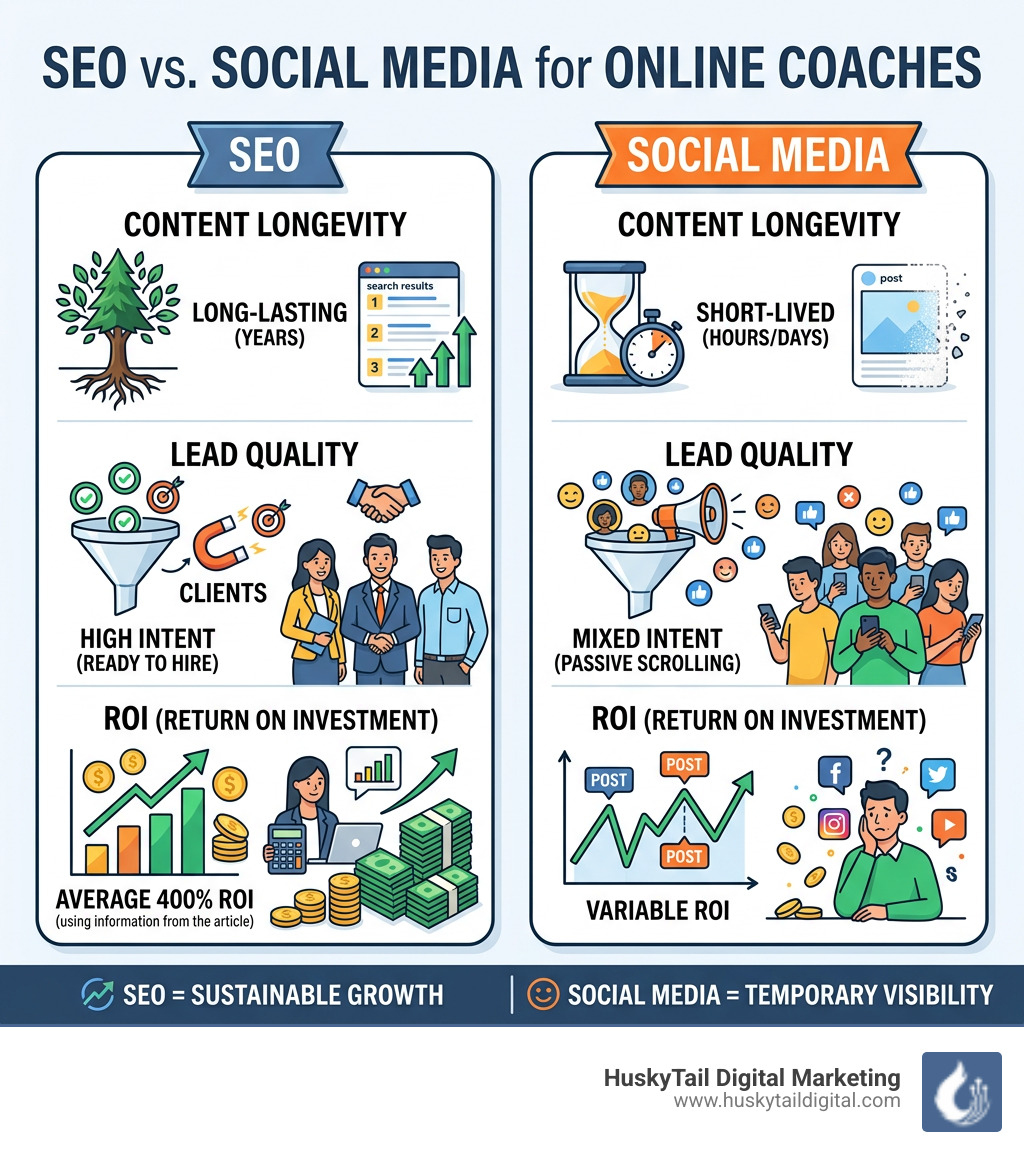
Social media demands constant content. Post today, gone tomorrow. SEO works differently — a well-written article can bring in clients for years without you touching it again.
And here's a number that should stop you in your tracks: 70% of consultants get zero leads or calls from their website each month. That's not a website problem. That's an SEO problem.
If you're good at what you do but invisible online, this guide is for you.
I'm Stephen Gardner, founder of HuskyTail Digital Marketing and an SEO and AI-driven digital marketing strategist with over 20 years of experience helping service-based businesses answer the question of do online coaches and consultants need SEO — and then doing something about it. I've built search strategies for businesses ranging from local practices to national brands, and I'm going to walk you through exactly what works for coaches and consultants who want clients without the social media grind.
Quick do online coaches and consultants need seo terms:
Do Online Coaches And Consultants Need SEO?

In online business, if you aren't visible on the first page of search results, you effectively don't exist to a massive portion of your market. When we ask do online coaches and consultants need SEO, we have to look at the sheer volume of people looking for help. Every single month, there are a staggering 1.5 million searches for life coaches, business coaches, and executive coaches.
Think about that for a second. That is 1.5 million people actively raising their hands and saying, "I have a problem, and I need an expert to help me solve it." If your website isn't optimized, those 1.5 million people are finding your competitors instead. Furthermore, research shows that approximately 66% of consumers do their homework online before they buy any service. Your website is your digital handshake—the very first impression you make. Without a solid SEO strategy, that handshake never happens.
Why do online coaches and consultants need SEO to escape the social media treadmill?
The "social media treadmill" is a real phenomenon. You spend hours filming a Reel or writing a LinkedIn post, it gets some engagement for 24 hours, and then it vanishes into the digital abyss. You have to start all over again the next day just to stay relevant.
SEO provides evergreen traffic. When you rank for a valuable keyword, that page stays there, working for you while you sleep, while you're on vacation, or while you're actually coaching your clients. It bridges the "lead gap"—remember, 70% of consultants report getting zero leads from their site. By implementing SEO, you transform your website from a "deserted digital island" into a lead-generation machine. If you want to stop chasing likes and start attracting clients, check out our get more clients ultimate guide.
How do online coaches and consultants need SEO to target high-intent leads?
There is a massive psychological difference between "interruption marketing" (social media) and "intent marketing" (search). On social media, you are interrupting someone's scroll through cat videos or family photos. On Google, the user is the one initiating the conversation.
By targeting problem-oriented keywords (e.g., "how to stop micromanaging") and goal-oriented phrases (e.g., "executive leadership coaching in Chicago"), you meet potential clients exactly when they are most motivated to seek help. This is why leads from search engines convert at a rate of 14.6%, while paid ads only convert at a measly 1.7%. Following Google Search Essentials ensures that your high-value content is actually discoverable by those who need it most.
Service-Based SEO Vs. E-commerce Strategies
One of the biggest mistakes we see is coaches trying to use e-commerce SEO tactics for a service-based business. If you're selling a $15 t-shirt, the purchase is impulsive. If you're selling a $5,000 coaching package, the "trust threshold" is much higher. People don't just click "buy" on a consultant; they research, they read your blog, and they look for proof of your expertise.
For consultants, local SEO services are often the quickest path to success. Even if you work remotely, appearing in local searches builds immediate trust. People naturally prefer working with someone "near" them, even if the meetings happen on Zoom.
Niche targeting for online coaches
The broader you are, the harder it is to rank. If you call yourself a "life coach," you are competing with millions of people. If you are a "career coach for introverted tech managers," you've just slashed your competition and increased your relevancy.
We help our clients identify their "Ideal Client Avatar" and build a link building complete guide strategy that targets long-tail keywords. These are specific phrases that might have lower search volume but much higher conversion rates because they match exactly what the user wants.
Local SEO for consultants
Consultants can dominate their local markets by using geo-targeted keywords. Ranking for "business consultant in Austin" or "marketing consultant in Miami" is significantly easier than ranking for "business consultant" globally. Local SEO involves optimizing your Google Business Profile, collecting local reviews, and ensuring your contact information is consistent across the web. This proximity ranking allows you to become the "go-to" expert in your city.
Technical Foundations And Content Mastery
You can have the best coaching advice in the world, but if your website takes ten seconds to load, Google won't show it to anyone. Technical SEO is the foundation of your digital house. This includes ensuring your site is mobile-friendly (since more than half of all traffic is mobile), has an SSL certificate for security (HTTPS), and has a clean site architecture that search engines can easily crawl.
If you're unsure where your site stands, our technical SEO complete guide covers the essentials. A secure, fast, and easy-to-navigate site isn't just for Google—it's for your users' experience, too.
Content creation for authority
In the coaching world, content is king (or queen!). But "thin" content won't cut it anymore. The average Google first-page result contains 1,447 words. Google wants to see that you are a "Trusted Authority."
We encourage coaches to write cornerstone articles—deep dives into specific problems their clients face. Instead of a 300-word "top 5 tips" post, write a 2,000-word guide on "The Comprehensive Framework for Overcoming Executive Burnout." This type of empathy-driven writing proves your expertise before you even get on a call. Regular SEO audits can help you identify which pieces of content are performing and which need a refresh to stay relevant.
Keyword research and tools
Effective keyword research isn't just about finding words with high volume; it's about finding words with the right intent. We use advanced platforms like Ahrefs and SEMRush to analyze search volume and keyword difficulty.
For coaches, we look for:
- Niche-defining keywords: What you do (e.g., "SaaS Sales Consultant").
- Problem-oriented keywords: What they’re struggling with (e.g., "high employee turnover").
- Goal-oriented keywords: What they want (e.g., "how to double revenue in 12 months").
The ROI Of Search And The AI Future
The return on investment for SEO is one of the highest in the marketing world. Small businesses that commit to SEO see an average 400% return on their investment within two years. For every dollar you spend on SEO, you can expect to get back around $2.75. Compare that to the "pay-to-play" model of ads, where the moment you stop paying, the leads stop coming.
However, the landscape is shifting. We are now entering the era of "SEO 2.1," where we must also optimize for AI search assistants like ChatGPT, Perplexity, and Claude. These tools "shortlist" experts based on their authority across the web. This means your SEO strategy must extend beyond your website to include your presence on LinkedIn, YouTube, and other authoritative platforms.
Measuring success and timelines
SEO is a marathon, not a sprint. It typically takes 6 to 12 months for a well-executed strategy to properly take effect. Why? Because Google needs time to build trust with your site. We use tools like Google Analytics and Search Console to track:
- Organic Traffic: How many people are finding you.
- Keyword Rankings: Where you stand for your target terms.
- Conversion Rates: How many visitors are actually booking calls.
Managing SEO: DIY vs. Specialist
Can you do SEO yourself? Technically, yes. You can learn the basics, write your own content, and use plugins like Yoast. However, SEO has become increasingly complex. Between algorithm updates that happen several times a year and the technical requirements of modern search, many coaches find that their time is better spent coaching rather than wrestling with site maps and schema markup. Hiring a specialist allows you to scale your results faster and ensures your strategy is backed by data, not guesswork.
Frequently Asked Questions
What are common SEO mistakes coaches make?
The most common mistake is keyword stuffing—forcing keywords into sentences where they don't belong. It makes you look unprofessional to humans and gets you penalized by Google. Other big ones include ignoring local SEO, having a slow site speed, and publishing thin content (short posts that don't actually help anyone). Also, many coaches write for their peers instead of their clients, using jargon that their ideal audience doesn't actually search for.
Do I need to be a tech expert to do SEO?
Not at all. Modern platforms like WordPress make it easier than ever to manage content. The "heart" of SEO for coaches is empathy and expertise. While technical foundations are important, those can be handled by tools or partners, allowing you to focus on the high-quality writing that resonates with your clients.
How does SEO compare to paid ads?
Paid ads are like a faucet: turn them on, and leads flow; turn them off, and they stop. SEO is like planting an orchard: it takes time to grow, but once it does, it provides fruit for years. Furthermore, search leads convert at a rate 7.3x higher than paid ads in financial and professional services because the trust factor is already established through your content.
Conclusion
At HuskyTail Digital Marketing, we understand that you didn't become a coach to spend your life staring at spreadsheets or fighting with Instagram algorithms. You became a coach to change lives. Our AI-powered SEO and website management services are designed to give you the visibility you deserve without the social media burnout.
We provide AI-certified, data-backed results that put your brand in the spots that matter. And we’re proud to say that our work goes beyond just marketing; through our Hearts for Huskies initiative, we combine expert growth strategies with a commitment to giving back.
At HuskyTail Digital Marketing - We Don't Follow the Pack, We Lead the Herd.
Ready to stop chasing the algorithm and start owning the search results? Book a discovery call for SEO services today and let's build your sustainable lead-generation machine.


.avif)

.webp)
.avif)


