
-p-1080.webp)






Why AI Marketing Insights Are Reshaping Business Growth
AI marketing insights are the data-driven findies that emerge when artificial intelligence analyzes vast amounts of customer behavior, campaign performance, and market trends—turning raw numbers into actionable strategies. Here's what you need to know:
- What they are: AI processes massive datasets to reveal patterns, predict outcomes, and recommend actions that human analysis would miss or take weeks to uncover.
- Why they matter: 72% of organizations globally now use AI, with 65% leveraging generative AI specifically—nearly double from 2023.
- How they help: AI delivers efficiency gains (6.2% boost in sales productivity), improved customer satisfaction (7% increase), and lower costs (7.2% reduction in marketing overhead).
- Key applications: Content creation (47% of companies), customer segmentation (44%), personalization (42%), and predictive analytics (46%).
The marketing landscape has fundamentally changed. What used to require teams of analysts and weeks of manual work now happens in seconds. AI doesn't just speed up decisions—it surfaces insights that were previously invisible, from predicting which customers will churn to identifying the exact message that will convert a hesitant prospect.
I'm Stephen Gardner, founder of HuskyTail Digital Marketing, and I've spent over 20 years helping businesses turn data into revenue through strategic digital marketing. Since integrating AI marketing insights into our client campaigns, I've witnessed how these tools transform struggling businesses into market leaders by replacing guesswork with precision. The gap between companies that accept AI marketing insights and those that don't is widening rapidly—and it may soon become unbridgeable.

The AI Revolution In Marketing: Current Applications And Benefits
The conversation around AI in marketing has shifted dramatically. We're not talking about future possibilities anymore—we're talking about what's working right now on our desktops, in our campaigns, and across our customer touchpoints.
According to the 2024 State of Marketing AI Report, many marketers now say they "couldn't live without AI." That's a remarkable statement, but when you look at the numbers, it makes complete sense. Global AI adoption jumped from 50% to 72% in just one year. This isn't a trend—it's a fundamental change in how marketing gets done.

Primary Ways Marketers Use AI
AI has become the Swiss Army knife of modern marketing—versatile, reliable, and surprisingly good at tasks we once thought required exclusively human judgment.
Content creation leads the pack at 47% adoption, and for good reason. AI doesn't just help you draft that blog post faster; it generates social media updates, video scripts, and even image concepts. The beauty is that it frees human creativity to focus on strategy and refinement instead of wrestling with writer's block at 2 AM.
Close behind is customer segmentation at 44%. We've moved far beyond basic demographics like "women aged 25-34." AI analyzes behavioral patterns, purchase histories, and engagement data to create segments so specific they feel almost custom-built. This precision makes every dollar of your marketing budget work harder.
Personalization sits at 42% adoption, and this is where segmentation pays off. AI tailors messages, offers, and experiences to individual users in real-time. It's the difference between "Dear Customer" and a message that speaks directly to someone's actual needs and interests.
Predictive analytics (46%) gives marketers something we've always dreamed of: a crystal ball that actually works. AI forecasts market trends, predicts which customers might leave, and identifies who's ready to buy. These AI marketing insights transform reactive marketing into proactive strategy.
Here's something that surprised me: quality assurance leads all categories at 50%. AI checks ad copy for consistency, validates customer data, and spots errors faster and more thoroughly than human reviewers. It's not glamorous, but it prevents costly mistakes.
Sentiment analysis (39%) uses Natural Language Processing to understand how people feel about your brand. AI reads through thousands of social media posts, reviews, and comments to gauge public perception—something that would take a team of humans weeks to accomplish.
Finally, creative evaluation at 43% means AI can actually predict which ads, images, or videos will perform best before you spend a dime on them. It analyzes elements and suggests improvements based on what's worked with similar audiences.
For a deeper look at how AI transforms search optimization specifically, our guide on AI-Powered SEO Strategies breaks down the technical side.
Key Benefits for Modern Marketing Teams
The real question isn't whether AI works—it's how well it works. The numbers tell a compelling story.
Productivity boosts are immediate and measurable. When AI handles data entry, report generation, and routine optimization tasks, your team gets time back for strategic thinking and creative development. One client told me they reclaimed nearly 15 hours per week—time that now goes into building better customer relationships.
Accelerated campaign performance changes the game entirely. AI monitors campaigns in real-time, spots opportunities, and makes adjustments while you sleep. This agility means you're not waiting until next quarter to fix what's broken—you're optimizing continuously.
Improved creativity might seem counterintuitive. Doesn't AI make things more robotic? Actually, it's the opposite. AI generates dozens of ideas, angles, and variations, giving human marketers a rich palette to work from. As marketing experts note, AI acts as an amplifier—it empowers us to focus on higher-order activities like strategy and storytelling rather than getting stuck in the brainstorming phase.
Cost reduction happens naturally when you're not wasting resources on ineffective strategies. AI helps allocate budgets to channels and messages that actually convert. One study showed that effective AI implementation led to a 7.2% decrease in marketing overhead costs—that's real money back in your budget.
Improved decision-making is perhaps the most valuable benefit. AI processes millions of data points to surface AI marketing insights that would take humans months to uncover. According to research, this translates to a 6.2% increase in sales productivity and a 7% increase in customer satisfaction. When you combine those metrics, you're looking at strategic business value that affects your entire bottom line.
For more context on how businesses are leveraging AI across industries, The state of AI in 2024 from McKinsey provides comprehensive data on adoption trends and outcomes.
The revolution isn't coming—it's already here. The question is whether you're ready to be part of it.
Deep Dive: How AI Transforms Personalization And Customer Journeys
Generic marketing messages don't work anymore. Your customers scroll past them without a second glance because they've seen thousands just like them. What stops the scroll? Content that speaks directly to them—their needs, their timing, their preferences. That's the power of AI-driven personalization, and it's not just nice to have. For 59% of global marketers, AI for campaign personalization and optimization is the most impactful trend ready to make a difference by 2025. In North America, that number jumps to 60%.
The difference between traditional personalization and what AI enables is like the difference between addressing someone by their first name in an email versus anticipating exactly what they need before they ask for it. AI transforms customer journeys from predetermined paths into dynamic, responsive experiences that adapt in real-time to each person's behavior.
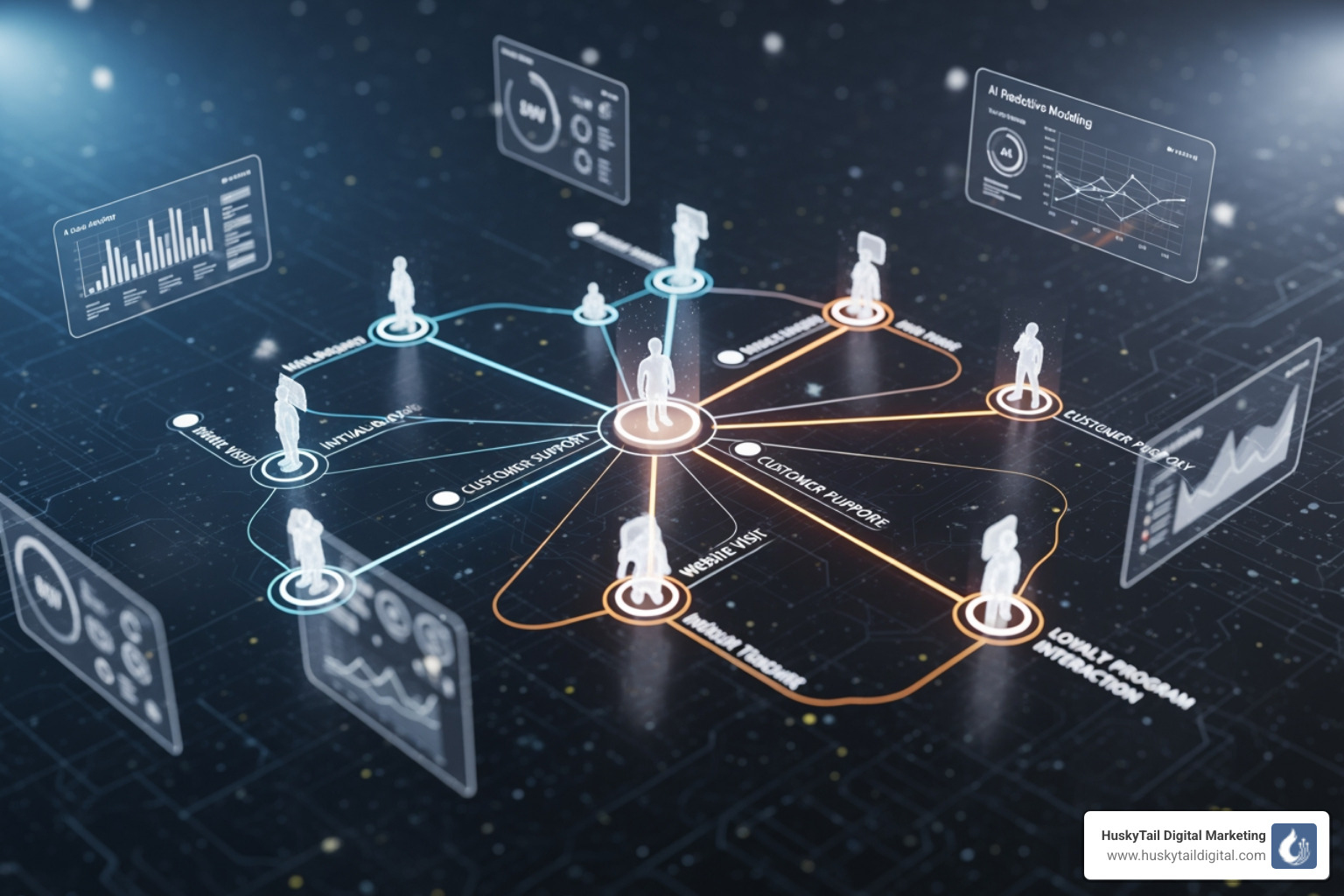
Enhancing Customer Segmentation with Machine Learning
Remember when customer segmentation meant dividing people by age, location, and income? Those days are gone. Machine learning has completely reimagined how we group and understand our audiences, moving far beyond basic demographics into the nuances of actual behavior.
Dynamic segmentation means your customer groups aren't frozen in time. They shift and evolve as people's behaviors change. Someone who was browsing casually last week might show purchase intent today, and AI catches that shift immediately, moving them into a different segment that receives more targeted messaging.
Behavioral clustering is where things get really interesting. Machine learning identifies patterns that humans would never spot—groups of customers who share similar browsing habits, content preferences, or purchase triggers, even if they look completely different on paper. A 25-year-old in Seattle and a 50-year-old in Miami might belong to the same behavioral cluster because they interact with your brand in identical ways.
The ability to predict likelihood to churn gives you a crystal ball for customer retention. AI analyzes hundreds of signals—declining engagement, changed browsing patterns, reduced purchase frequency—and flags customers who are drifting away before they're actually gone. This gives you time to intervene with personalized retention offers or outreach.
Perhaps most valuable are the cross-sell opportunities AI uncovers. By analyzing past purchases and browsing history alongside similar customer patterns, AI identifies which products a customer is likely to want next. It's not guessing; it's calculating probability based on thousands of data points. This approach to understanding customers through machine learning is changing how marketers make strategic decisions, as detailed in resources like How AI enhances decision-making.
The shift to first-party data collection has made this level of segmentation even more critical. As we move into a cookieless future, the data you collect directly from your customers becomes your most valuable asset. AI helps you extract maximum value from that data, turning customer interactions into rich, actionable AI marketing insights.
Crafting Hyper-Targeted Campaigns and Data-Driven Journeys
Once you understand your customers at this granular level, the next step is meeting them with exactly the right message at exactly the right moment. This is where AI moves from analysis into action, orchestrating customer journeys that feel less like marketing and more like helpful guidance.
Next-best action prediction is AI working behind the scenes to map out the optimal path for each customer. Should they receive an email? See a retargeting ad? Get a special offer? AI continuously analyzes their behavior and predicts which action will move them closer to conversion. It's like having a strategist dedicated to each individual customer, working 24/7 to determine the perfect next step.
Personalized content delivery extends across every touchpoint. The website homepage someone sees adapts to their interests. Email subject lines change based on what's most likely to get them to open. Ad creatives shift to showcase products they've shown interest in. Every piece of content becomes a personalized experience rather than a one-size-fits-all message.
Dynamic ads powered by AI take this even further, adapting in real-time to individual user profiles. The same ad placement might show completely different products, messaging, or offers to different people based on their browsing history, purchase behavior, and predicted interests. This makes every ad impression count.
AI-powered chatbots have evolved far beyond the frustrating "I didn't understand that" responses of early automation. Modern AI chatbots provide genuinely helpful, personalized support that guides customers through their purchasing journey. They answer questions, make recommendations, and solve problems in real-time. The impact is significant: 64% of agents using AI chatbots spend more time on complex issues, compared to just 50% without them. The AI handles routine questions, freeing humans for the conversations that need a personal touch.
With 50% of U.S. consumers using voice assistants for daily queries, voice search optimization has become essential. AI analyzes the tone, phrasing, and semantics of spoken queries to understand user intent in ways traditional keyword matching never could. This helps you create content that answers questions the way people actually ask them, making your brand findable in this growing search channel.
Managing all these personalized touchpoints requires sophisticated technology. AI CRM tools have become the command center for these data-driven customer journeys, integrating insights and actions across every channel to create seamless experiences.
The result? Marketing that doesn't feel like marketing. It feels like a brand that understands you, anticipates your needs, and delivers value at every interaction. That's the change AI brings to personalization and customer journeys.
The Marketer's AI Toolkit: Predictive, Prescriptive, And Generative Models
Understanding the different types of AI available to marketers is like learning which tool to grab from your toolbox—each one solves specific problems in unique ways. The AI landscape might seem overwhelming at first, but it really boils down to three main categories: predictive AI (which tells you what's likely to happen), prescriptive AI (which recommends what you should do about it), and generative AI (which creates new content from scratch).
Think of it this way: predictive AI is your fortune teller, prescriptive AI is your strategic advisor, and generative AI is your creative assistant. When you combine all three, you've got a powerhouse toolkit that transforms how we approach marketing challenges.
Understanding the Types of AI in Marketing
Predictive AI has become the backbone of modern marketing forecasting. When you're trying to figure out which leads are most likely to convert, predictive models analyze thousands of data points—past behaviors, engagement patterns, demographic information—to assign scores that help your sales team prioritize their efforts. It's the same technology that powers demand forecasting, helping you anticipate inventory needs or budget for seasonal campaigns before they happen.
Prescriptive AI takes things a step further by not just predicting outcomes, but actually recommending the best course of action. Say you're running multiple campaigns across different channels with a limited budget—prescriptive AI analyzes performance data and suggests exactly how to reallocate your spending for maximum ROI. It can also recommend which A/B test variations to run next based on what's worked before, turning your optimization process from guesswork into a science. As noted in The AI Revolution: How Predictive, Prescriptive, And Generative AI Are Reshaping Our World, these AI types are fundamentally changing how businesses operate.
Generative AI is probably the type you've heard most about lately, and for good reason. Tools like ChatGPT and Jasper have democratized content creation, allowing marketers to draft blog posts, craft compelling ad copy, and even generate images in minutes rather than hours. But it's not about replacing human creativity—it's about amplifying it. Generative AI handles the heavy lifting of first drafts and variations, freeing you up to focus on strategy, refinement, and that human touch that truly resonates with audiences.
Most Impactful AI Marketing Tools
The AI tool landscape is vast, but certain platforms have proven themselves indispensable for modern marketing teams. ChatGPT leads the pack for conversational AI and content ideation, while Jasper AI specializes in marketing-specific copy generation with brand voice consistency. HubSpot has integrated AI throughout its platform, offering intelligent lead scoring, content optimization, and automated workflows that adapt to customer behavior.
For video content, Synthesia enables you to create professional AI-generated videos without cameras or studios—just scripts and avatars. Fullstory uses AI to analyze user behavior on your website, surfacing AI marketing insights that reveal exactly where visitors struggle or drop off. Zapier automates workflows between hundreds of apps, with AI suggesting the most efficient automation sequences for your specific needs.
Grammarly has evolved beyond spell-checking into an AI writing assistant that understands tone, clarity, and engagement. Brand24 monitors your brand mentions across the web, using AI sentiment analysis to alert you to potential crises or opportunities in real-time.
For those looking to integrate AI into their SEO strategy specifically, exploring resources in our AI SEO Blog Category will help you understand how these tools work together to drive organic growth.
The key isn't to use every AI tool available—it's to select the ones that solve your specific challenges and integrate them into a cohesive workflow. At HuskyTail Digital Marketing, we've tested dozens of these platforms to identify which combinations deliver the best results for our clients, ensuring that AI improves rather than complicates their marketing efforts.


.avif)

.webp)
.avif)


