
-p-1080.webp)






Beyond Just Browsing: The AI Revolution In How We Use the Web
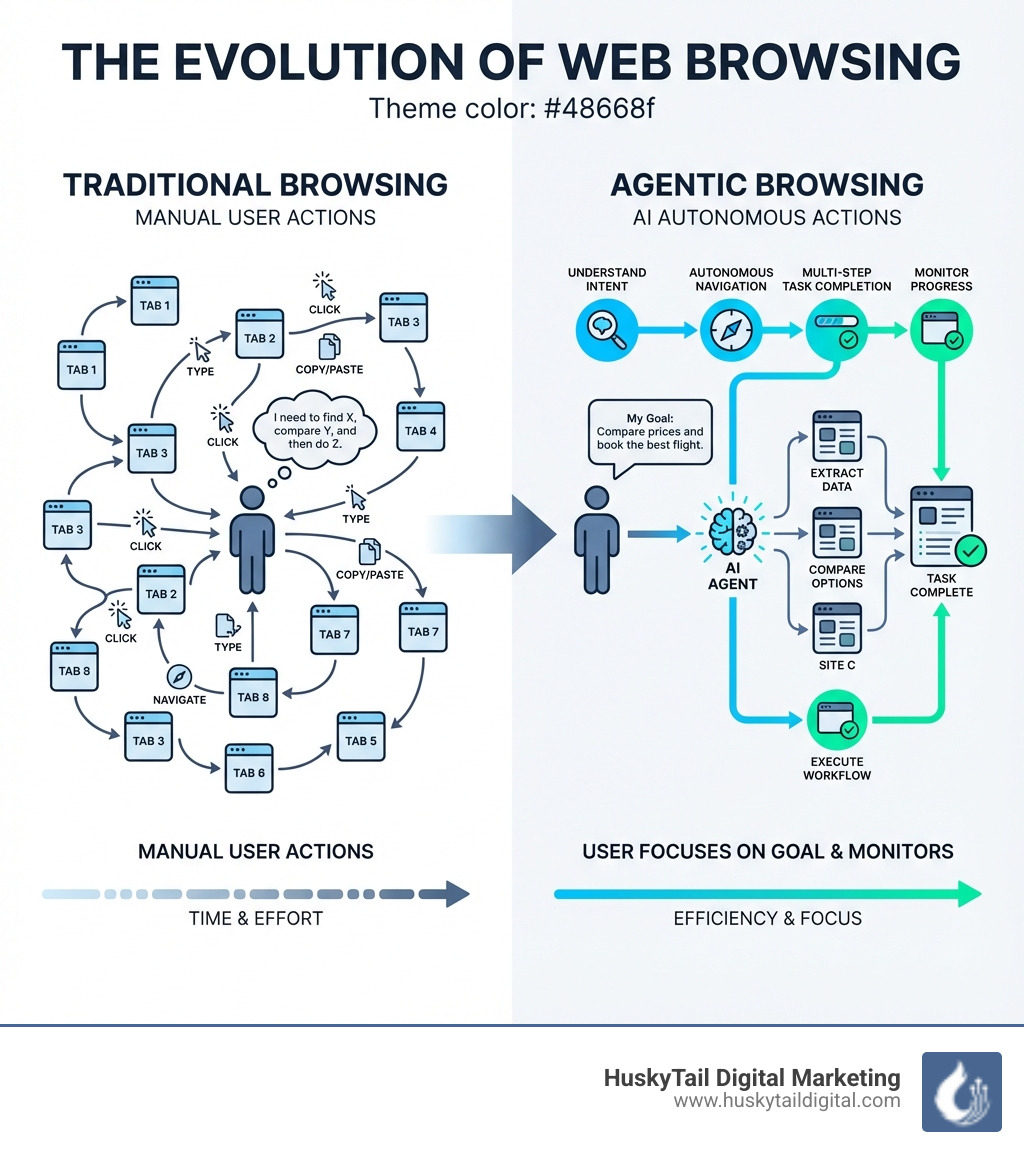
Agentic web browsing is when AI agents autonomously steer websites, complete tasks, and make decisions on your behalf—changing your browser from a passive display tool into an intelligent assistant that can book reservations, research competitors, extract data, and execute multi-step workflows while you focus on higher-value work.
Key differences at a glance:
The web browser is evolving from a document viewer into an intelligent agent that acts on your behalf. Instead of opening five tabs, manually copying information into Notion, and summarizing it yourself, you simply say: "Compare pricing and features of Airtable, Coda, and Notion, and give me a 3-paragraph summary." And it gets done.
This isn't a distant concept—it's happening now. Over the past few months, I've been testing the new generation of agentic browsers, and I realized this represents a real shift in how we use the internet. Companies like Perplexity, Fellou, and Brave have launched browsers where AI doesn't just help you search or read faster—it understands your intent and takes action.
Some publishers have already seen traffic from Google search fall by as much as 60% since the rollout of AI Overviews. When AI Overviews appear, the first organic link loses an average of 34.5% of its clicks. The economics of the web are changing, and businesses need to understand what this means for their visibility and strategy.
The change is driven by three core capabilities:
- AI agents can understand context from natural language requests
- They can autonomously steer websites like a human would
- They can execute complex, multi-step tasks across multiple sites
I'm Stephen Gardner, founder of HuskyTail Digital Marketing, and I've spent over 20 years helping businesses adapt to shifts in digital search and findy—from early SEO to mobile-first indexing to voice search. Now, I'm helping clients prepare for agentic web browsing, which may be the most fundamental change to internet interaction since the smartphone.
What Are Agentic Browsers And How Do They Work?
Imagine your web browser not just displaying information, but actively working for you. That's the essence of agentic web browsing. Unlike traditional browsers, which are essentially tools for viewing content and require us to manually click, type, and steer, agentic browsers are powered by sophisticated AI agents. These agents can understand our goals, autonomously interact with websites, and complete multi-step tasks on our behalf.
This shift marks the emergence of what researchers are calling the "Agentic Web". It's a change from a network of linked documents into an ecosystem where intelligent, interactive agents are constantly at work. We, the human users, remain the end-users, but the "mid-users"—those actively navigating, processing, and interacting with the web—are increasingly AI agents. These Web Agents are intelligent systems capable of autonomously interacting with internet resources, such as web pages and search engines, to accomplish complex tasks including multi-step reasoning, information retrieval, question answering, and data integration. They don't just find information; they use it.
From Passive Viewer to Active Doer: The Core Difference
The most profound difference between traditional and agentic browsers lies in the interaction model. With traditional browsers, we are passive consumers, actively searching, clicking, and synthesizing information ourselves. We're the ones juggling multiple tabs, copying data, and trying to piece together answers from disparate sources. It's a high-cognitive-load activity.
Agentic web browsing flips this script, moving us from passive consumption to active delegation. Instead of us doing the work, we delegate tasks to our browser. The mantra shifts from "Google it" to "Delegate it." This means we simply state our intent – what we want to achieve – and the agentic browser takes over, breaking down the task, navigating the necessary websites, and executing the steps. This delegation dramatically reduces our cognitive load, freeing us up to focus on the higher-level thinking and decision-making that humans do best.
The Brains of the Operation: The Role of Large Language Models (LLMs)
At the heart of every agentic browser lies a powerful Large Language Model (LLM). These LLMs are the "brains of the operation," serving as the decision-making core that enables the browser's agentic capabilities.
Here's how LLMs empower agentic browsers:
- Understanding Natural Language: LLMs allow us to communicate our intentions in plain language, just as we would to a human assistant. The browser understands "book a flight to Miami" or "compare these three CRM tools" without needing precise keywords or complex commands.
- Reasoning Capabilities: Beyond simple comprehension, LLMs can reason about the task at hand. They can break down a complex request into a series of smaller, actionable steps.
- Planning and Execution: Based on their reasoning, LLMs plan the optimal sequence of actions required to achieve our goal. This might involve visiting multiple websites, filling out forms, extracting specific data points, or even making decisions based on real-time information.
- Perceiving the Environment: LLMs, integrated with the browser's interface, can "perceive" the web environment. They can read and interpret webpage content, identify interactive elements like buttons and forms, and understand the context of what's displayed on screen. This allows them to dynamically adapt their actions as they steer.
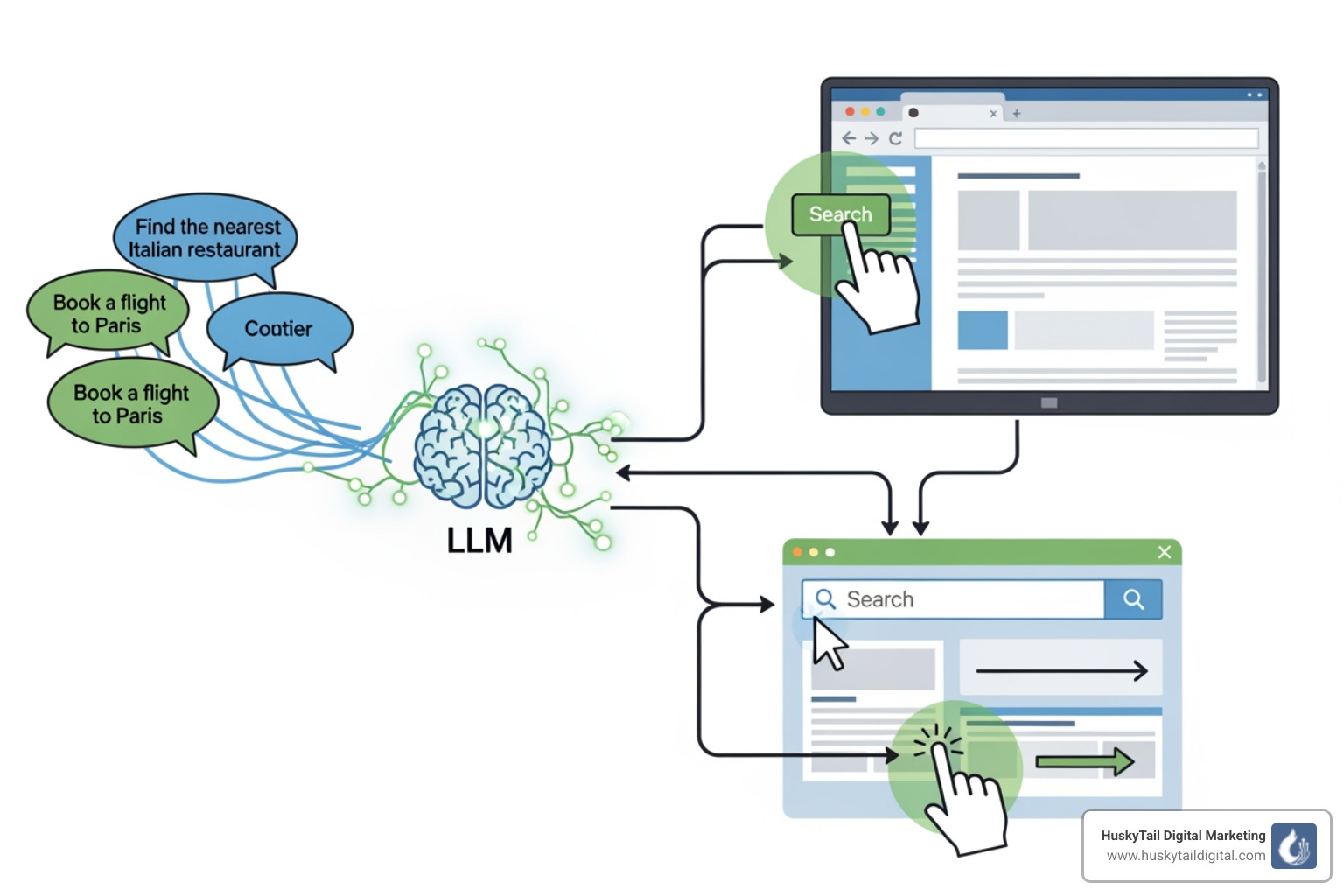
This sophisticated interplay between our natural language instructions and the LLM's ability to reason, plan, and execute within the dynamic web environment is what makes agentic web browsing so transformative.
The Power Of Delegation: Key Benefits And Real-World Use Cases
The advent of agentic web browsing isn't just a technological curiosity; it's a game-changer for how we interact with the internet, promising a significant boost in productivity and efficiency. Imagine having a digital assistant that never sleeps, never complains, and can handle mundane online tasks with lightning speed.
Statistics show that over 30% of repetitive digital tasks could be automated by 2030. Agentic browsers are at the forefront of this automation revolution. They don't just help us search or read faster; they understand our intent and take action, summarizing content, booking meetings, extracting data, and even interacting with multiple websites on our behalf. This translates directly into hours saved, allowing us to redirect our valuable time to more strategic endeavors. One user noted that it condensed 8 hours of work into 6 hours of freedom—a remarkable productivity multiplier!
This new paradigm also facilitates what we call "browsing at scale." Tools like Orca, for example, demonstrate how AI can help us view, steer, organize, extract, operate, and synthesize information across numerous web pages simultaneously. This capability dramatically improves information foraging and synthesis, making it easier to gather comprehensive data and draw informed conclusions from vast amounts of online content.
Boosting Productivity with Agentic Web Browsing
The core promise of agentic web browsing is its ability to automate tasks that previously consumed significant chunks of our time. Think about the hours we spend on:
- Data Extraction: Pulling specific pieces of information from various websites for reports or spreadsheets.
- Form Filling: Completing repetitive online forms, whether for applications, surveys, or registrations.
- Booking Appointments: Navigating complex scheduling systems for meetings, reservations, or services.
- Workflow Automation: Stringing together multiple online actions across different platforms to achieve a larger goal, like researching a topic, compiling findings, and then summarizing them in a document.
We're talking about streamlining entire workflows. Instead of manually sifting through search results, opening dozens of tabs, and carefully copying and pasting data, we can simply instruct an agentic browser to handle it all. This frees us from the digital busywork, allowing us to focus on analysis, creativity, and strategic thinking.
From Research to Reservations: Practical Examples
The real magic of agentic web browsing comes alive in its practical applications. Here are some compelling examples of how these intelligent agents are already making a difference:
- Comparative Analysis: Instead of opening five tabs, pasting info into Notion, and summarizing it manually—we just say: "Compare pricing and features of Airtable, Coda, and Notion, and give me a 3-paragraph summary." The agentic browser handles the entire process, delivering a concise report.
- Market Research: Imagine asking your browser to "research 2025's top EdTech startups, including funding, key investors, and market positioning." Fellou, for instance, has demonstrated the ability to deliver a VC-style report with trends, insights, and early-stage opportunities in minutes—a task that would normally take a week to compile.
- Product Analysis: Similarly, an agentic browser could research "the top 10 menstrual health apps, functions, pricing, reviews, funding, and more," providing insights as efficient as a top product intern.
- Booking and Planning: Advanced agents, like ChatGPT Atlas, can move beyond simple search to perform automated tasks like booking reservations or even planning and purchasing ingredients for a Japanese breakfast or other meals.

These examples highlight how agentic web browsing transforms our online experience from a series of manual interactions into a seamless delegation of complex tasks, allowing us to achieve our goals with unprecedented efficiency.
A Look At The Leading Agentic Browsers In 2025
The landscape of agentic web browsing is rapidly evolving, with several platforms pioneering this new frontier. Some are "AI-native," built from the ground up with agentic capabilities, while others are "AI-improved," integrating AI features into existing browser architectures. Here's a look at some of the leaders we've explored:
Perplexity Comet
Perplexity’s Comet browser is one of the most ambitious agentic browsing projects we've seen. Leveraging Perplexity's existing AI search expertise, Comet integrates autonomous agents that can steer websites, analyze content, and complete complex tasks. It's designed to browse websites on its own, delivering structured summaries with specific examples. We've seen it effectively analyze cybersecurity articles, organizing findings into clear sections and citing examples like the University of Kansas Health System.
Initially available only to Perplexity Max subscribers at $200/month, Perplexity made Comet accessible to all users at no cost, demonstrating a commitment to broader adoption of its powerful capabilities.
Fellou
Fellou positions itself as an AI-native browser designed specifically for agentic workflows. It’s not retrofitting AI onto an existing browser; Fellou has built its platform from the ground up to support autonomous agent interactions. Its focus is squarely on productivity use cases, especially deep research and automation.
Fellou has shown remarkable capabilities, researching top EdTech startups and menstrual health apps, delivering VC-style reports and in-depth product analyses in minutes. It claims to be 3.1x faster than OpenAI for certain tasks and offers report creation that is more complete than other deep research tools. For us, Fellou could redefine how we interact with information online, making Chrome look ancient for certain tasks.
Brave Leo
Brave Leo stands out for its strong emphasis on privacy. It provides comprehensive functionality immediately without requiring signup or payment for its core features. Brave Leo maintains privacy by storing conversations locally and processing requests without collecting personal data. Users can connect various LLMs, including Mixtral 8x7B, Claude Instant, and Llama 2 13B, often with local AI processing options.
We found Brave Leo consistently summarized webpages and analyzed technical articles across all our tests, providing relevant follow-up questions without any signup. For users in areas like Atlanta, Austin, or Chicago who prioritize data privacy, Brave Leo offers a compelling solution.
Dia
Dia browser takes a developer-focused approach to agentic web browsing. It provides tools and APIs that allow users to create custom AI agents for specific web interaction scenarios. The platform emphasizes programmability and customization, making it ideal for technical users who want to build specialized automations. Dia aims for an "AI-first" and "AI-native" experience, featuring a conversational interface and intelligent navigation built from the ground up for AI interaction. This approach allows for a high degree of control and flexibility in how agents operate and interact with the web.
The Risks and Realities Of Agentic Web Browsing
While agentic web browsing promises unparalleled efficiency and productivity, it's crucial for us to acknowledge and understand the potential drawbacks and risks. This isn't just about the technology's capabilities, but also its implications for our privacy, security, and even our relationship with online information.
The autonomy of AI agents introduces new challenges. What happens if an AI agent makes a mistake? What if it accesses data it shouldn't? We're dealing with "automated accidents" and the potential for a "loss of control" if the AI's actions don't align with our true intent. Furthermore, the extensive data access permissions required for agentic browsers raise significant concerns about how our personal information is handled.
Privacy, Security, and the Problem of Prompt Injection
One of the most critical areas of concern is the intersection of privacy, security, and AI's inherent vulnerabilities.
- Data Collection Concerns: For agentic browsers to operate effectively, they often require extensive data access. This can lead to privacy risks related to cross-site tracking and the aggregation of our personal information across various online interactions. While some browsers, like Brave Leo, prioritize local processing, others might send data to cloud servers.
- Indirect Prompt Injection: A particularly insidious security flaw identified in agentic browsers like Perplexity Comet is indirect prompt injection. This occurs when malicious web content, unbeknownst to the user, embeds instructions that the AI agent then interprets and executes as legitimate commands. This can lead to the AI taking unintended or harmful actions. As research on Agentic Browser Security highlights, such vulnerabilities could allow attackers to manipulate AI actions, compromise accounts, or even facilitate unauthorized transactions. This is a crucial area for ongoing development and user vigilance.
- AI Accuracy: While LLMs are powerful, they are not infallible. We must consider the potential for AI "hallucinations" or inaccuracies in the information they process or the actions they take.
Balancing Autonomy and User Control
The fundamental tension in agentic web browsing lies in balancing the AI's autonomy with our need for user control. Different browsers approach this balance in various ways:
- User Oversight: While agents can act autonomously, many platforms incorporate mechanisms for user oversight. This might include visualizing the agent's actions, allowing for real-time intervention, or requiring explicit confirmation for sensitive tasks.
- Browser Memories: Some browsers, like ChatGPT Atlas, offer "browser memories" that track visited sites to personalize responses. Critically, these are often opt-in features, allowing us to control what gets saved and providing options like incognito mode browsing to prevent data collection. By default, browsing content isn't used for training unless we explicitly opt-in.
- Local Data Storage and Zero Retention: Privacy-focused browsers like Brave Leo process requests without collecting personal data and store conversations locally. Arc Max implements transparent data sharing with AI partners using zero retention policies for user interactions, meaning our data isn't kept after the interaction.
The goal is to empower us with intelligent assistance without surrendering complete control over our digital lives. We believe that transparency, clear opt-in/opt-out mechanisms, and robust security measures will be paramount for the widespread adoption and trust in agentic browsers.
The Future Is Agentic: How Browsers Will Reshape The Web And SEO
The rise of agentic web browsing isn't just changing how we use the internet; it's fundamentally reshaping the entire web ecosystem. For businesses in markets like New York, Los Angeles, or Dallas, this shift has profound implications for how we connect with our audiences, especially concerning publishers, advertisers, and our SEO strategies.
Publishers are already feeling the impact. Some have seen traffic from Google search fall by as much as 60% since the rollout of its AI Overviews, which often provide direct answers and summaries, reducing the need for users to click through to original sources. When AI Overviews appear, the first organic link loses an average of 34.5% of its clicks. This presents a significant challenge to traditional advertising and content monetization models.
Advertising models are also under pressure. AI agents may filter out ads or reduce the "dwell time" on pages, impacting ad impressions and conversions. However, this also opens new avenues for AI-mediated recommendations and highly targeted, intent-based advertising.
For us at HuskyTail Digital Marketing, this isn't just about adapting; it's about pioneering. We specialize in AI-powered SEO and website management, and we're seeing a clear shift from traditional SEO to "Agent Optimization" (AO). It's about ensuring your digital presence is not just findable by humans, but comprehensible and actionable by AI agents.
The 'Agentic Web' and What It Means for Your Website
The "Agentic Web" envisions a future where webpages aren't just static documents but active participants in an ecosystem of intelligent agents. This means that:
- Webpages as Agents: Your website will increasingly need to function as an "agent" itself, with defined capabilities and clear interfaces that AI can understand and interact with.
- Hyperlinks as Coordination Channels: Traditional hyperlinks, once merely navigational paths, will evolve into coordination channels that facilitate communication and task decomposition between different AI agents.
- API-First Strategies: Websites will need to adopt API-first development strategies. This means building robust Application Programming Interfaces (APIs) that allow AI agents to efficiently access specific data and perform tasks programmatically, rather than relying solely on visual scraping.
- Structured Data and Schema.org Markup: The importance of structured data, particularly using Schema.org markup, will become paramount. This provides machines with explicit, semantic information about your content, making it easier for AI agents to understand, categorize, and use your data.
- Machine-Readable Content: Beyond structured data, the overall content of your website needs to be highly machine-readable. This means clear, concise language, consistent terminology, and logical organization that AI can easily parse and interpret.
AI agents will evaluate websites not just on their visual appeal or human-friendly navigation, but on their functionality, data quality, and ease of task completion.
Preparing Your Site for Agentic Web Browsing
So, how do we prepare our websites for this agentic future? It requires a proactive approach to web design and development that considers both human users and AI agents.
- Clean Navigation and Consistent Layouts: AI agents thrive on predictability. Websites with clear navigation structures, consistent layouts, and logical information hierarchies will be easier for agents to parse and interact with. This is especially true for e-commerce sites or booking platforms in cities like Orlando or Phoenix.
- Prioritize Data Quality Over Visuals: While aesthetics remain important for human engagement, the underlying data quality and structure will be king for AI. Ensure your product data, service descriptions, and informational content are accurate, up-to-date, and well-organized.
- Dual Interfaces (Human & AI): We'll likely see a rise in hybrid interfaces. These will offer a visually rich experience for human users while simultaneously providing a highly structured, machine-readable layer for AI agents. This might involve robust APIs working silently behind the scenes.
- Accept Structured Data and APIs: This cannot be stressed enough. Implement Schema.org markup wherever possible for product details, services, reviews, business information (for our clients in Tampa, San Francisco, or any of our other locations), and more. Develop and expose APIs for key functionalities and data sets on your site.
- Be "Agent-Friendly": Think about how an AI agent would interact with your site. Can it easily find pricing information? Can it fill out a contact form? Can it identify key features of a product? The easier it is for an agent to accomplish a goal on your site, the more likely your site will be favored in agentic interactions.
For local businesses in places like Denver, Houston, or Philadelphia, ensuring your local SEO is optimized for both human search and agentic queries will be vital. At HuskyTail Digital Marketing, we help our clients adapt their websites to these evolving standards. We can help you with your website's technical SEO to ensure it's ready for this new era.
Frequently Asked Questions About Agentic Browsing
What's the simplest way to define agentic browsing?
Agentic web browsing is when you tell your browser what you want to achieve, and an AI agent figures out how to do it, navigating websites and taking actions for you. It's like having a personal assistant for the internet.
Will agentic browsers replace traditional browsers like Chrome?
Not immediately. For now, they are emerging as powerful alternatives for specific tasks, especially research and automation. Over time, traditional browsers will likely integrate more agentic features, blurring the lines.
How do I prepare my business's website for this new technology?
Focus on strong technical SEO fundamentals: use structured data (like Schema), ensure your site has a logical structure, and consider providing APIs for key data. The easier it is for a machine to understand your site, the better it will perform in the agentic web.
Are You Ready For The Agentic Web?
The shift in how we interact with the internet is profound and happening at an accelerated pace. From simple information retrieval to complex task execution, agentic web browsing is more than a fleeting trend; it's the next evolution of our digital lives. It promises to transform how we work, learn, and engage with the vast resources of the web, turning our browsers into powerful, proactive assistants.
As we steer this exciting, yet complex, new landscape, businesses across the United States, from the vibrant markets of Las Vegas to the busy tech hubs of San Diego, need to be prepared. At HuskyTail Digital Marketing, we specialize in helping businesses steer these technological shifts with AI-certified strategies; we don't follow the pack, we lead the herd. Our Hearts for Huskies initiative also means that by working with us, you contribute to a cause we deeply care about, combining ethical business with impactful giving.
The future of the web is agentic, and the time to adapt is now. Don't get left behind. Schedule a digital strategy consultation with us today to ensure your business is not just ready, but thriving in the Agentic Web.


.avif)

.webp)
.avif)


